


Total Soft Bank (KOSDAQ: 045340, 토탈소프트뱅크) is a Busan-based maritime software house whose terminal operating system, CATOS, runs more than 110 container terminals in over 20 countries. It has a market value of roughly ₩57bn and holds about ₩34bn of that in cash.
If you’ve ever watched a giant container ship get unloaded, those towering cranes plucking forty-ton boxes off the deck like Lego bricks, there’s a decent chance the software choreographing that ballet was written in Busan, South Korea.
Despite the name, Total Soft Bank has nothing to do with the Japanese telecom-and-investing giant SoftBank. It’s a 37-year-old maritime-software house founded in 1988 and listed on the KOSDAQ since 2002, and it has spent its entire life solving one unglamorous, fiendishly hard problem: how do you run a port?
This is my first post here, and I want to use it to introduce a business I find genuinely fascinating — a tiny, profitable, cash-rich company sitting at the centre of an industry most investors never think about. Let’s get into it.
Before I start, credit where it's due: I'm not the first to write up TSB. Michael Fritzell (Asian Century Stocks) covered it in a deep-dive and Ryan Albert (@ryan_a_albert) in an X thread — both worth a read. I'd taken my position before I read either, and the model and analysis below are my own.
What Total Soft Bank actually does: CATOS and terminal operating systems
Ports are deceptively complex. A single large terminal handles thousands of containers a day, each one needing to be planned, tracked, stacked, moved, and loaded onto the right ship in the right order — without the vessel tipping over, the yard gridlocking, or a crane sitting idle. Get it wrong and you burn money by the hour. Get it right and you squeeze more throughput out of the same concrete.
TSB sells the brain that runs all of this. Its flagship product, CATOS (Computer Automated Terminal Operating System, 케이토스), is what the industry calls a Terminal Operating System — the central nervous system of a container terminal. It plans where ships berth, how the yard is laid out, how cranes and trucks are scheduled, and monitors the whole operation in real time. CATOS is installed at more than 110 container terminals across 20-plus countries.
Around that core, TSB has built a whole stack:
CASP / Cloud CASP — stowage planning for ships (how to physically load the boxes safely and efficiently). Used by a large share of the world’s biggest shipping lines.
TSB Supercargo — an onboard “loading computer” that calculates a vessel’s stability and structural strength.
MOST — an operating system for multi-purpose terminals (bulk, liquid, odd-shaped cargo).
PLUS — a port community system that links shippers, agents, carriers and authorities.
Simulators & training — crane, welding and painting simulators, plus a 3D “digital twin” platform delivered to a terminal in Vietnam in 2025.
The strategic logic is what they call vertical integration: TSB can supply software for the ship, the shipping line, the terminal, and the wider port community — a one-stop maritime IT shop. In an industry that increasingly wants integrated platforms rather than bolted-together point solutions, that’s a real advantage.
Why Total Soft Bank has a moat
Port operating software is about as sticky as software gets. Three things stand out:
Brutal barriers to entry. Terminals are critical infrastructure. Operators are conservative and risk-averse — nobody wants to be the person who installed the buggy software that gridlocked the national port. So they buy from a tiny club of vendors with long track records. TSB estimates only ~20 companies worldwide truly compete at the global level.
Long contracts, long relationships. These are multi-year deployments, often with maintenance tails that run for years afterward. Once your TOS is embedded, ripping it out is a nightmare. That makes revenue durable and recurring.
An oligopoly with structural tailwinds. Ships keep getting bigger, ports keep automating, labour keeps getting scarcer and more expensive, and global trade keeps getting more volatile (US–China tensions, supply-chain reshuffling). All of that pushes operators toward smarter, more automated systems — exactly what TSB sells. The company is also leaning into a subscription/SaaS model (cloud CATOS, cloud CASP), which over time should mean more predictable, recurring revenue.
This is a classic “picks and shovels” story: TSB doesn’t own ports or ships, it just sells the indispensable software that makes them run — and gets paid whether trade is booming or merely chugging along.
Total Soft Bank Q1 2026 results: revenue up 39%
On to the part that made me want to write this. TSB reported its Q1 2026 results (the three months ending 31 March 2026), and they were excellent.
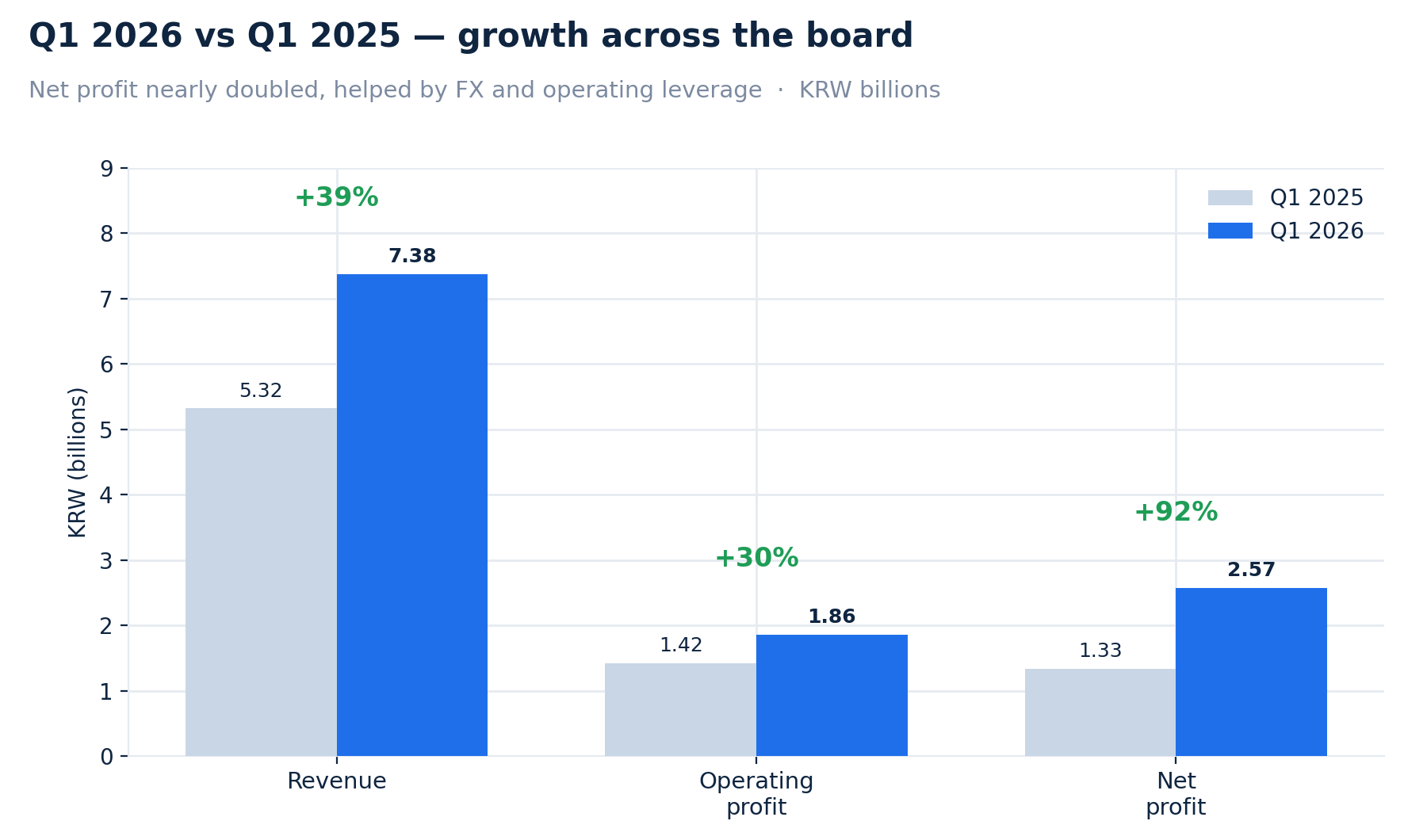
Revenue: ₩7.38bn, up ~39% year-on-year.
Operating profit: ₩1.86bn, up ~30%, for an operating margin north of 25%.
Net profit: ₩2.57bn, up a remarkable ~92% — nearly doubling.
Roughly 80% of revenue came from CATOS, underlining how central the flagship product is. It’s worth noting the net-profit surge was flattered by foreign-exchange gains — TSB earns the large majority of its revenue abroad (in USD, EUR and others), so a weaker won inflates reported profit. Strip out the FX noise and the underlying operating story is still very healthy, just less explosive than that +92% headline suggests. Always read the won-denominated profit of an exporter with one eye on the currency.
For context, this isn’t a one-off. Full-year FY2025 revenue was about ₩27.5bn with operating profit of ₩9.4bn — so the business has been compounding nicely, not just printing a single lucky quarter.
The order backlog: ₩38bn at Q1 2026
For a project-and-contract business like this, the single most useful forward-looking number isn’t quarterly revenue — it’s the order backlog (수주잔고), the work already signed but not yet recognised as revenue. It’s the closest thing to a crystal ball.
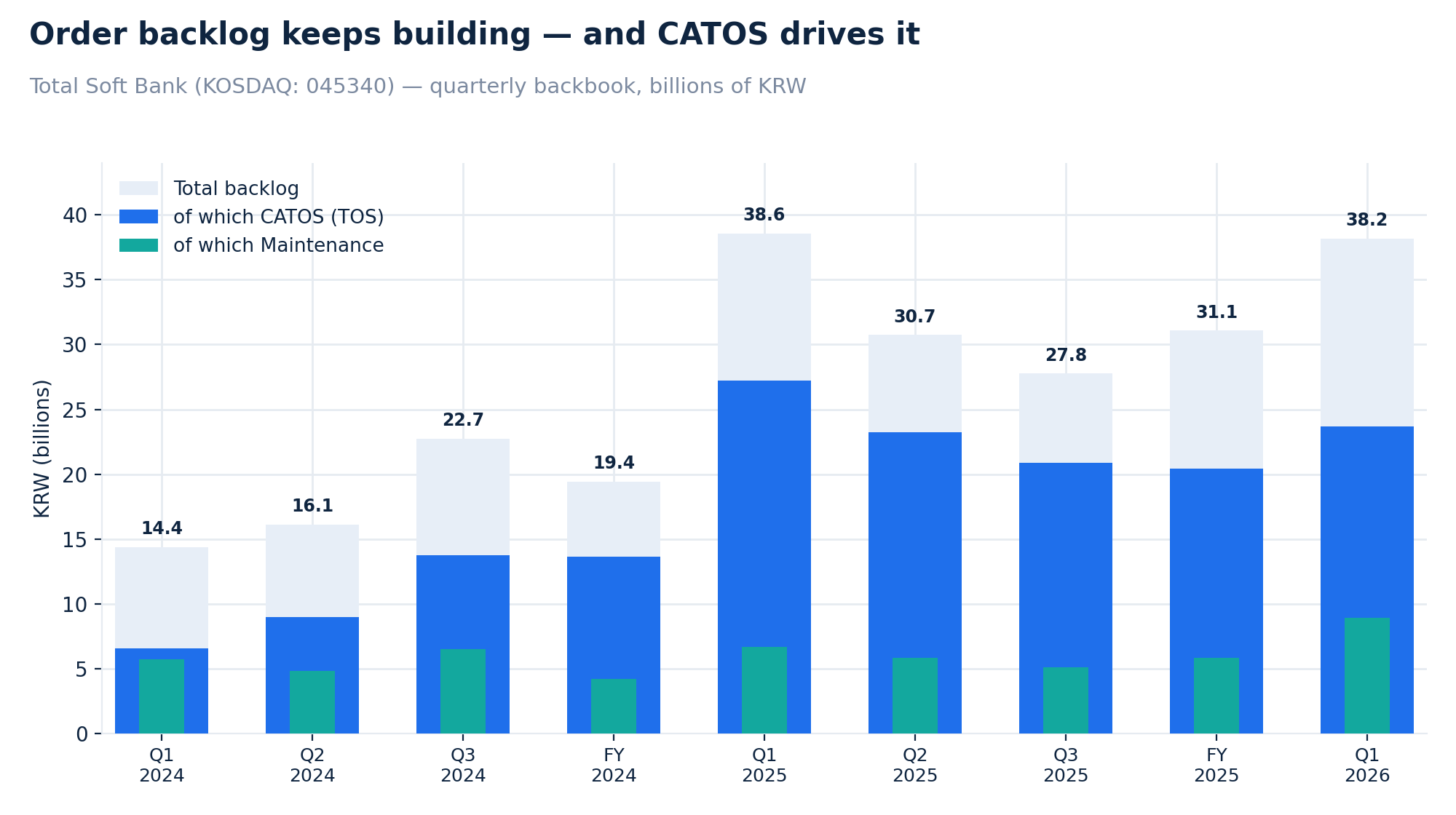
The trend is the story. Backlog roughly doubled between early 2024 and early 2025 as a wave of new contracts landed, and even after working some of it off, TSB ended Q1 2026 with ~₩38bn of backlog — back near its all-time highs. CATOS makes up the bulk of it, and notably the maintenance slice jumped to its highest level in the dataset (~₩8.9bn), which is exactly the kind of sticky, recurring revenue you want to see growing.
Put differently: TSB is sitting on a backlog worth well over a year of revenue. The recent contract announcements behind this include terminal-system deals in Abu Dhabi, Malaysia (Penang and Johor), Kenya, Spain (Valencia) and Taiwan — a genuinely global order book.
The balance sheet: ₩34bn of cash against a ₩57bn market cap
Here’s the part that really caught my eye. TSB is not just profitable — it is drowning in cash and carries essentially no debt.
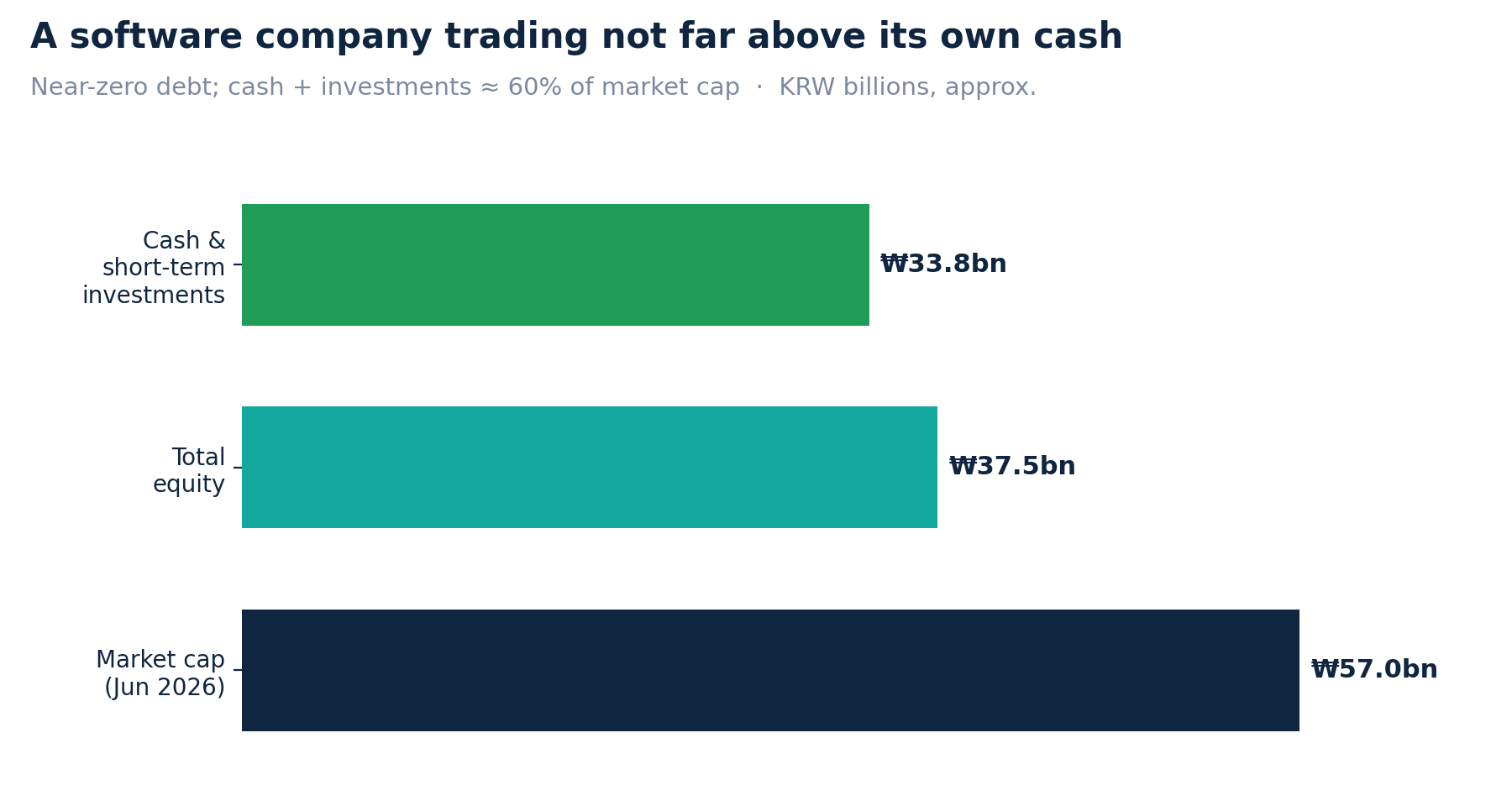
At the end of Q1 2026 the company held roughly ₩16bn in cash plus another ~₩18bn in short-term financial instruments — call it ~₩34bn in cash and near-cash. Against that, interest-bearing debt is a rounding error (a single small lease). The debt-to-equity ratio is under 50%, and the current ratio is a fortress-like ~390%.
Now compare that to the market value. As of early June 2026, Total Soft Bank's market capitalisation sits around ₩55–59bn. So cash and investments alone are close to 60% of the entire market cap. Back out the net cash and you’re paying a strikingly small amount for a profitable, growing, moaty software business.
The company is also returning capital: it paid a dividend for FY2025 (₩100/share) and has been buying back its own stock through a treasury-share trust in the first half of 2026. For a small Korean company, that shareholder-friendly behaviour is worth noting, especially against the backdrop of Korea's broader Value-Up push to get cash-hoarding companies to reward shareholders.
The risks in Total Soft Bank
No write-up is honest without the risks, and there are real ones:
It’s tiny and illiquid. This is a micro-cap on the KOSDAQ. Annual revenue is only around $18–20m. Position sizing and liquidity matter.
Lumpy, project-based revenue. Big contracts land unevenly. Any single quarter can swing hard, and government-tied port budgets can slip.
FX is a double-edged sword. The won’s weakness juiced this quarter’s profit. It can just as easily reverse and create a nasty-looking headline in the other direction.
Customer concentration. A handful of large terminal operators and shipping lines drive a big chunk of the order book — in Q1 2026, two customers alone were ~30% of revenue.
Founder/owner-led, old-guard governance. The founder-CEO was born in 1941 and still runs the company; the largest-shareholder group holds ~31%. That’s stability, but also key-person and succession risk, and the kind of governance overhang that has historically kept Korean small-caps cheap. (At the March 2026 AGM, a proposed executive-compensation rule was actually voted down — a small sign the shareholder base is engaged.)
The bottom line on Total Soft Bank
Total Soft Bank is the kind of company that almost never makes headlines: small, profitable, boring-in-a-good-way, sitting on a mountain of cash, and quietly embedded in the plumbing of global trade. It owns a defensible niche in an oligopolistic, high-barrier industry with secular tailwinds (automation, bigger ships, digitalisation), it’s growing its backlog, and it trades at a valuation that barely seems to credit the operating business at all once you account for the cash.
That combination — durable moat, net-cash balance sheet, growing order book, micro-cap obscurity — is exactly the sort of thing that tends to get overlooked precisely because it’s quiet.
I’ll be following the next couple of quarters closely, especially how much of that fat backlog converts to revenue and whether the SaaS transition starts showing up as more recurring, less lumpy income. If it does, the market may eventually have to start paying attention.
Since writing this I have covered several other overlooked Asian micro caps, including for example i-Scream Media (KOSDAQ: 461300) or KIYO Learning (TYO: 7353).
Sources. Total Soft Bank (토탈소프트뱅크, KOSDAQ: 045340) filings on DART: the Q1 2026 quarterly report (38th term) and the FY2025 annual report. Contract announcements and backlog data from the company's DART disclosures. Market data as of 5 June 2026. Won conversions at roughly ₩1,500 to the dollar.
How I work. I read the Korean filings myself. AI helps me with translation and with checking the arithmetic. Every judgement, model and conclusion here is mine.
Disclosure. Assume I own shares in every company I write about, and read accordingly. I don’t disclose individual positions or sizes.
Disclaimer. This is analysis for discussion, not investment advice, and not a recommendation to buy or sell anything. I’m not your adviser. The figures come from primary filings but I make mistakes, so check them yourself before you act. Micro caps carry real liquidity and volatility risk, and you can lose your money.
"Almost nobody is talking about it", and yet you don't mention Ryan Albert's name? https://x.com/ryan_a_albert/status/2055817568120922274?s=20
Interesting setup, thank you for the article. What % of shareholder returns (buybacks specifically) did they do? And are any more planned?