


A test strip is a piece of paper about the size of a stick of gum, and the number of allergies it can check is simply the number of thin lines you can print on it. Printing one more line costs almost nothing. That is one half of why this business works; the other half is that the strip only fits its own machine.
The shares trade at ₩4,955, which values PROTIA (KOSDAQ: 303360, 프로티아) at ₩63.8bn, about $45m.
Everything below is measured over the twelve months to 30 June 2026, the latest filed numbers.
Revenue ₩17.7bn. The June half grew 40%, the year before that 44%
Operating profit ₩4.7bn, a 26.3% margin
No borrowings, and ₩13.9bn of cash, 22% of the market value
10.7x EV/EBIT on the last twelve months, 8.3x on this year’s estimate
Peter Lynch had a name for this shape: a fast grower. Small, growing 20 to 25% or better, in an industry nobody follows, with the P/E below the growth rate. Here it is about 14 against 40. He also said fast growers are where investors lose the most money when the story breaks.
What PROTIA actually does
Your doctor wants to know what you are allergic to. The old way is the skin prick test: a grid marked on your forearm, a drop of each allergen, a prick through the skin, twenty minutes of waiting to see which spots swell.
PROTIA sells the newer way, and from the patient’s side there is almost nothing to it. A nurse draws blood from a vein, sends the tube off to a laboratory, and you are out of the room in two minutes.
In the lab it looks like this.
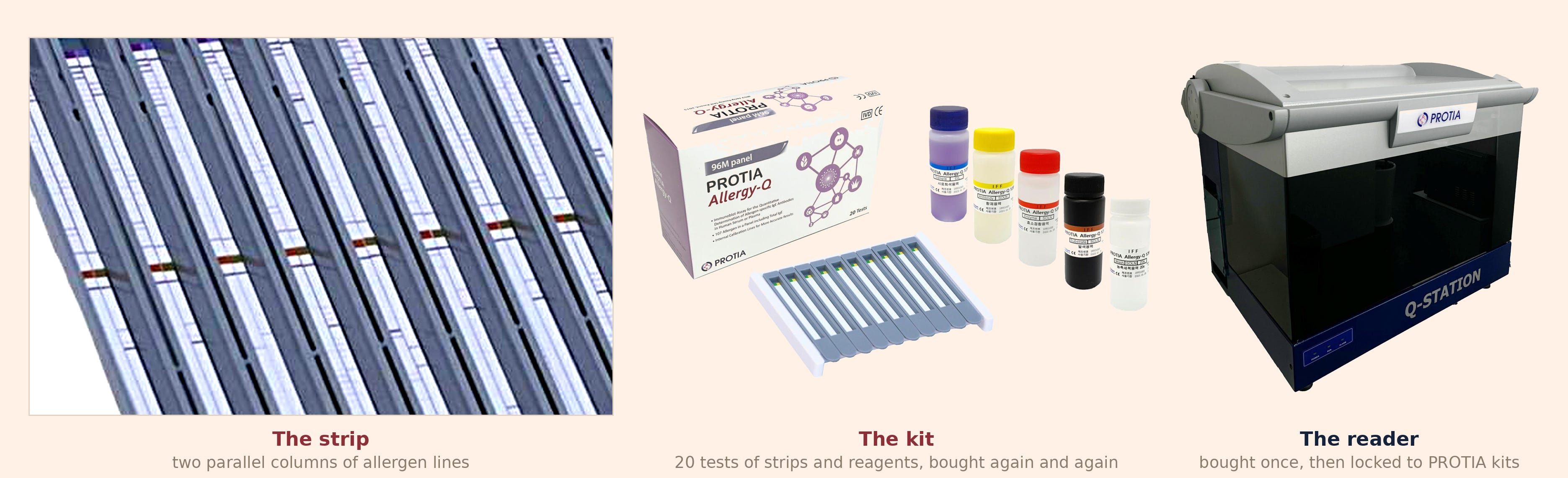
The grey plastic sticks are the test. Inside each is a small piece of paper with allergens printed on it as thin lines: one line cat, one dust mite, one peanut. A technician drips in a little of the patient’s blood serum. If you are allergic to cats, your antibodies grab the cat line and stay there. After a few washes the lines you react to go dark, and the machine on the right measures how dark each one went.
So the test is worth as many allergens as you can fit on that paper. And you cannot use a bigger piece: the strip must slide into the reader and sit in a standard tray, sized by equipment the industry already owns. Everyone is competing inside the same few square centimetres.
Most strips print one column of lines and hold 20 to 60 allergens. PROTIA prints two columns side by side, which you can see in the photo, and since March 2025 its newest kit prints four.
The competition is real, it just sits either side of PROTIA rather than on top of it. Rival line blots, including the one Revvity sells, fit around 50 allergens on a strip. PROTIA fits 176 on the same piece of paper. That is the patent doing its work.
Above them is better technology. An Austrian chip test called ALEX reads close to 300 allergens and beats anything PROTIA makes on breadth, but it costs about $138 a test in reagent alone, German statutory insurance will not pay for it, and NHS laboratories take requests for it from specialists only.
So PROTIA does not make the best allergy test in the world. It makes the densest one that fits the cheap, reimbursed, everyday slot, and that is where the routine volume sits.
The capsule machine
The strips only work in a PROTIA reader, and a PROTIA reader only reads PROTIA strips. A lab that buys the machine is signing up for PROTIA's consumables for the next decade. The reader sells once. The strips sell every week for ten years.
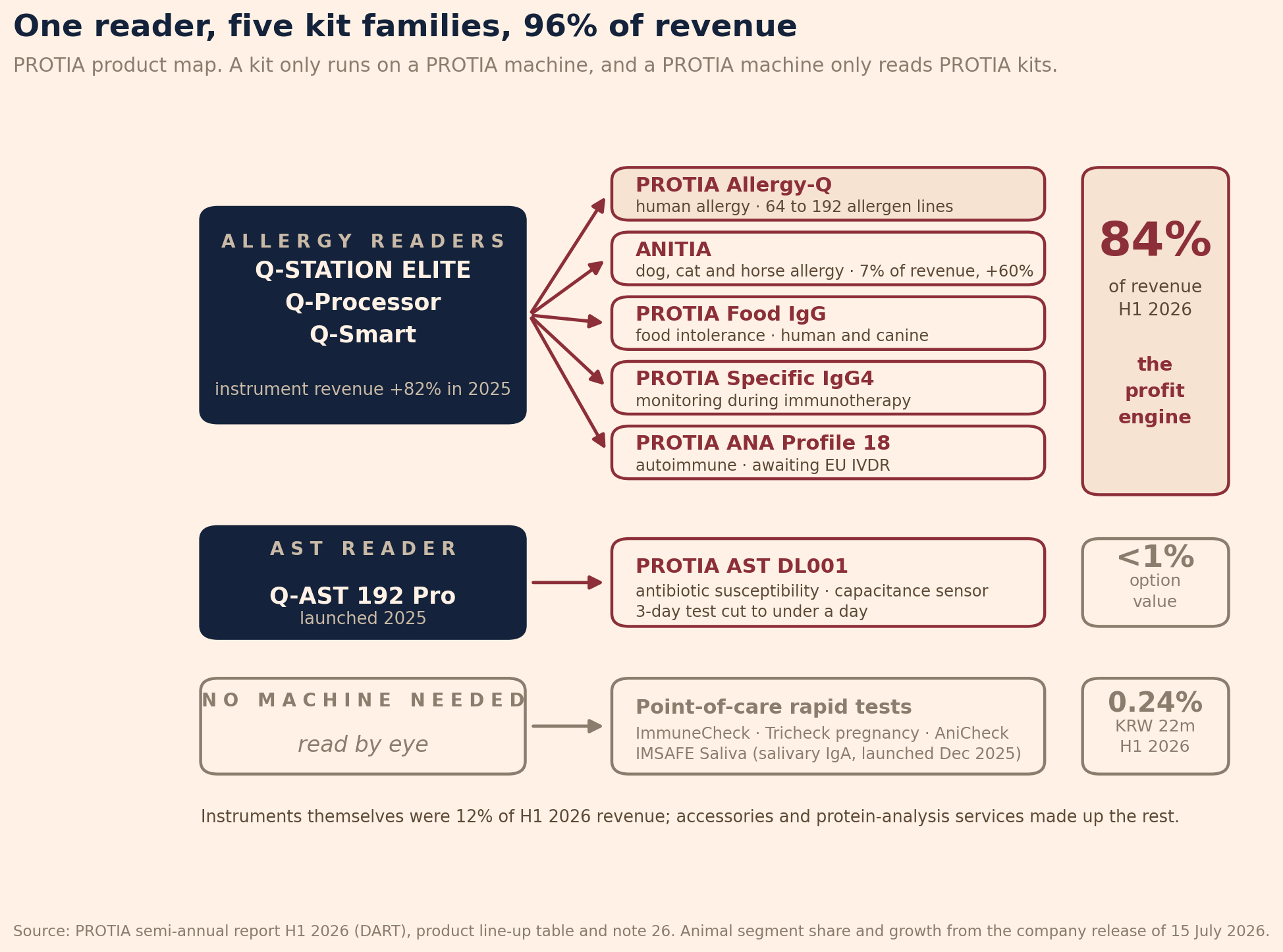
Five kit families run on those same three readers, so every new product walks straight into machines that are already installed and paid for. Kiwoom Securities puts the installed base at nine of Korea’s ten largest screening centres and contract labs. And because a reader has to be sitting on the bench before a single strip can be sold, the instrument line is the best forward indicator this business gives you. It jumped 82% in 2025 and now makes up 12% of sales.
The numbers
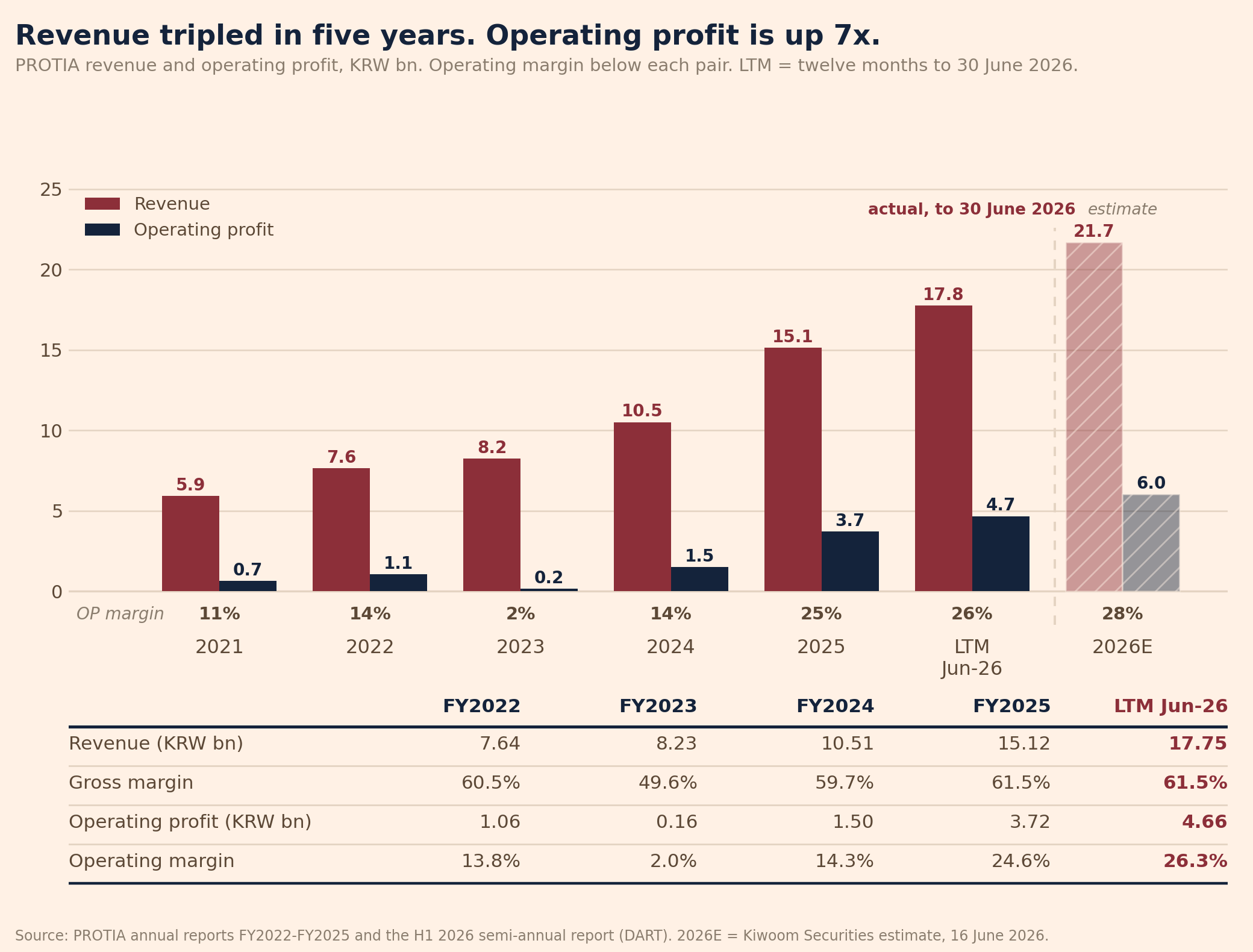
Two warnings on that table.
The reported P/E is flattered by tax. In late 2025 the company booked ₩342m of tax credits, which turned the year’s tax charge negative. That is why net profit of ₩5.5bn is higher than operating profit of ₩4.7bn. Screeners show a P/E of 12; on a normal tax rate it is nearer 14. The credits are gone, so operating profit grows about 62% this year while reported net profit grows about 30%.
Profits are not becoming cash. Net income from 2024 to June 2026 adds up to ₩9.4bn. Cash went up ₩0.9bn. Inventory swallowed ₩4.6bn of the difference and property took another ₩3.6bn, and in the June half the business threw off just ₩0.4bn of operating cash against ₩1.8bn a year earlier.
Why the margin moved
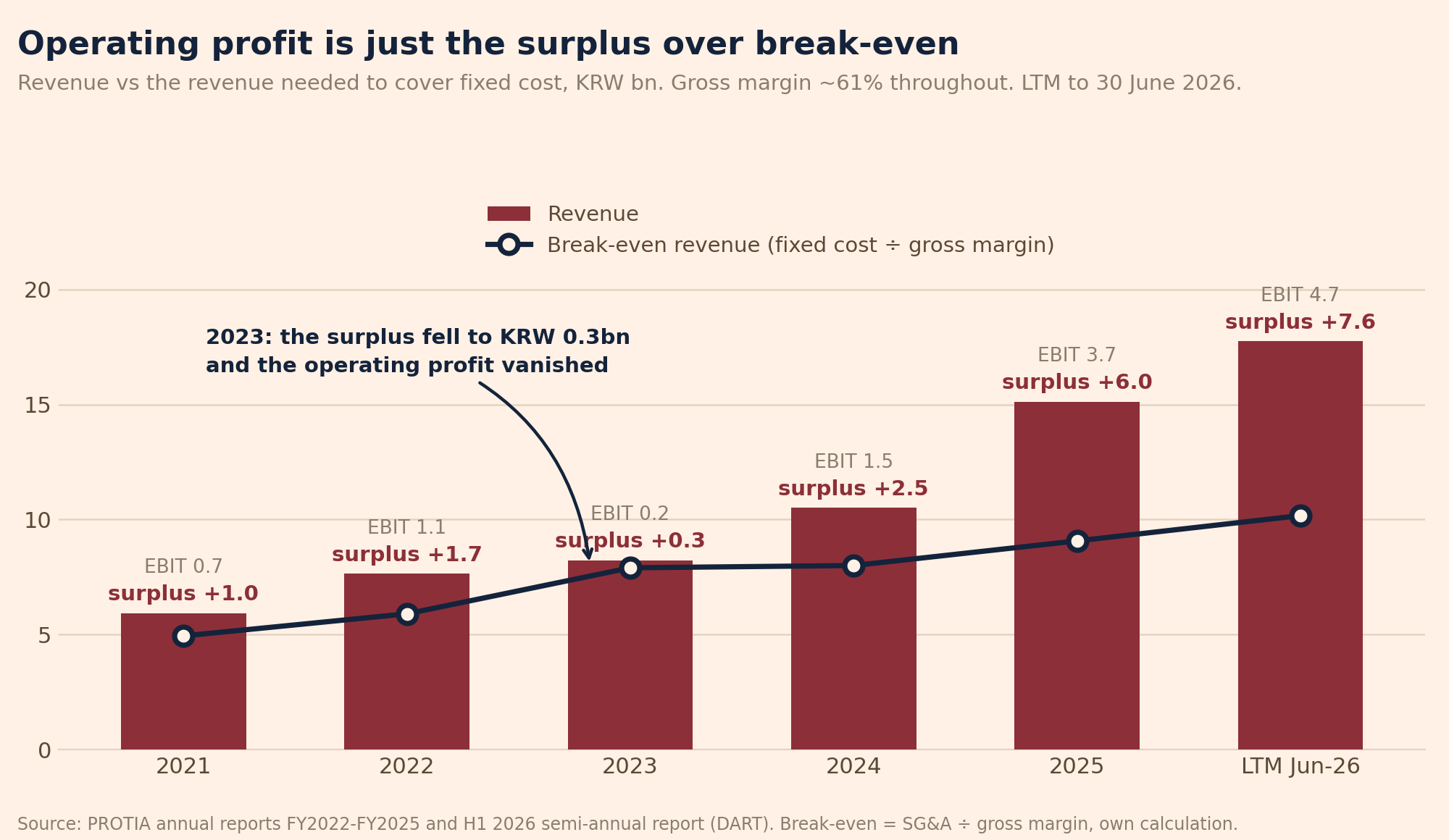
PROTIA pays for a set of things that barely move with sales: the lab, the quality team, the regulatory staff, the building. That bill came to ₩5bn when sales were ₩8bn, and today it is ₩6.3bn on sales of ₩17.7bn, so it has grown by a quarter while the top line has more than doubled.
Every ₩100 of sales leaves about ₩60 once the product is made, which means the company has to ship roughly ₩10bn of kits before it has covered that bill at all. Everything above the line is close to pure profit.
In 2023 sales landed only ₩331m above the line and the profit almost disappeared. Three new products started production at once with poor yields, the listing cost money, and Russian demand collapsed. Profit fell 84%.
Over the last twelve months sales landed ₩7.6bn above the line.
Nothing about the company changed. It just moved further from the line. That is the whole story of a margin going from 2% to 26%, and it cuts both ways: a bad year here does not trim the margin, it deletes it.
And the bill is already sized for a much bigger company than this one, so most of the next few years of growth should fall straight through to profit.
Where the growth comes from
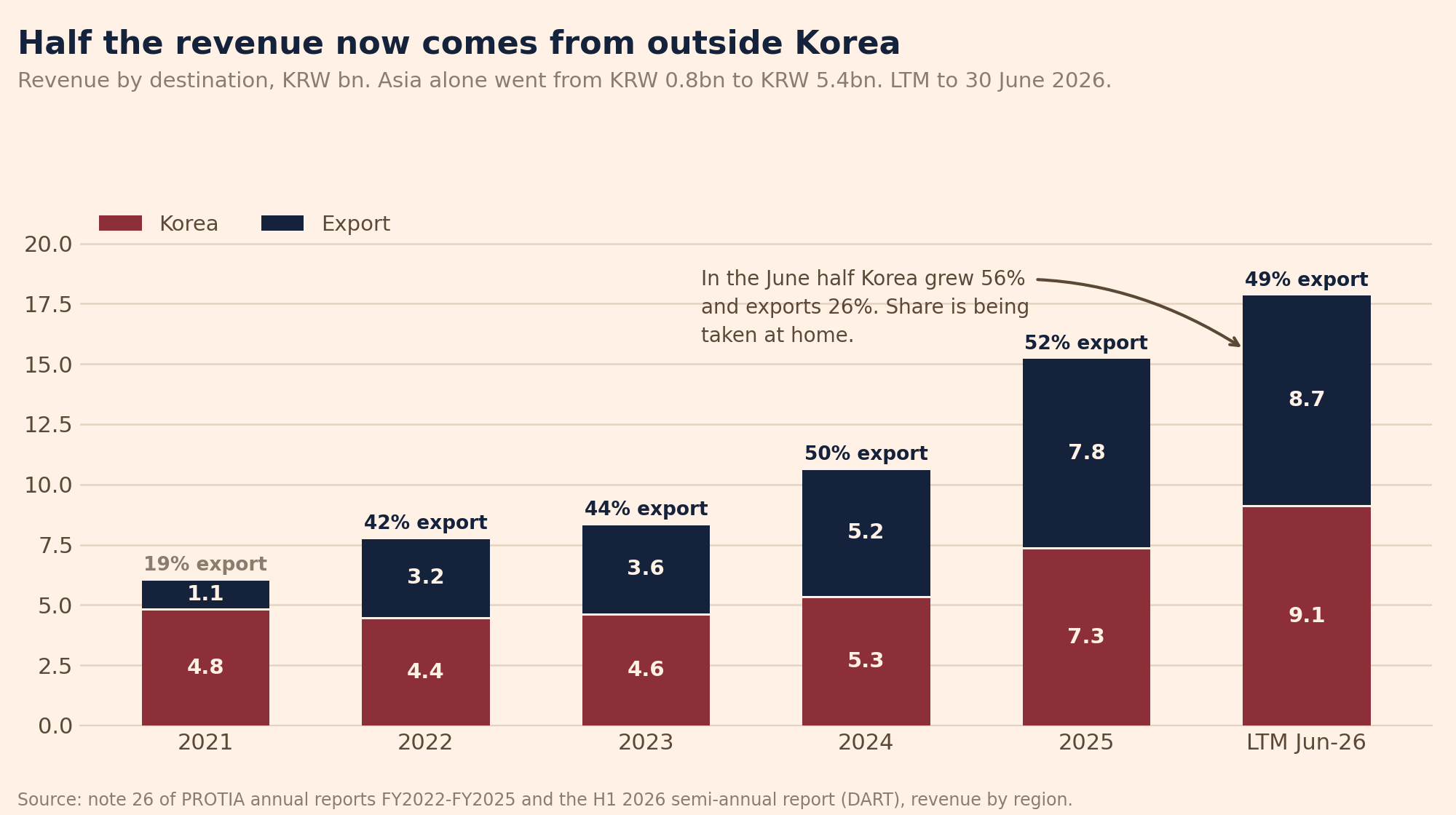
Exports were under a fifth of sales in 2021 and are 49% today. Asia alone went from ₩0.8bn to ₩5.4bn, and the distributor network from 54 countries to about 80. Even after all that, global share is still roughly 1%, in a market GMI sizes at $6.1bn today and $13.4bn by 2034.
The surprise in the June half is that home grew faster. Korea was up 56% and exports 26%. Korea finished converting from skin-prick to blood testing years ago, so that growth is share taken from the one real rival, a spun-out LG Chem division called Invitros. It comes concentrated, though: two unnamed customers are 33% of revenue, up from 29% a year ago, and one of them alone supplied a third of the growth in the half.
Two more products ride the same readers. Animal allergy testing grew over 60% in the first half and is 7% of sales, and the canine panel is the only one approved in Korea. Antibiotic susceptibility testing cuts a three-day lab test to under a day, which matters in sepsis.
The single house covering the stock, Kiwoom Securities, expects ₩21.7bn of revenue this year (+44%) and ₩6.02bn of operating profit (+62%), a 28% margin, and points to the European CE IVDR approvals for the 192D and the antibiotic products, due at the end of this year, as the driver for 2027. Kiwoom ran PROTIA’s listing, so this is not independent research, and the first half grew 40%, which means the second half has to speed up to 46%.
In March the chief executive went further and said the company will reach ₩100bn of revenue by 2030. Discount that heavily. In November 2024 he said 2025 would break ₩20bn and it came in at ₩15.1bn. The listing prospectus had promised ₩34.6bn for the same year. The targets are marketing. The delivered numbers, 44% growth in 2025 and 40% in the June half, are the part worth trusting.
The red flags
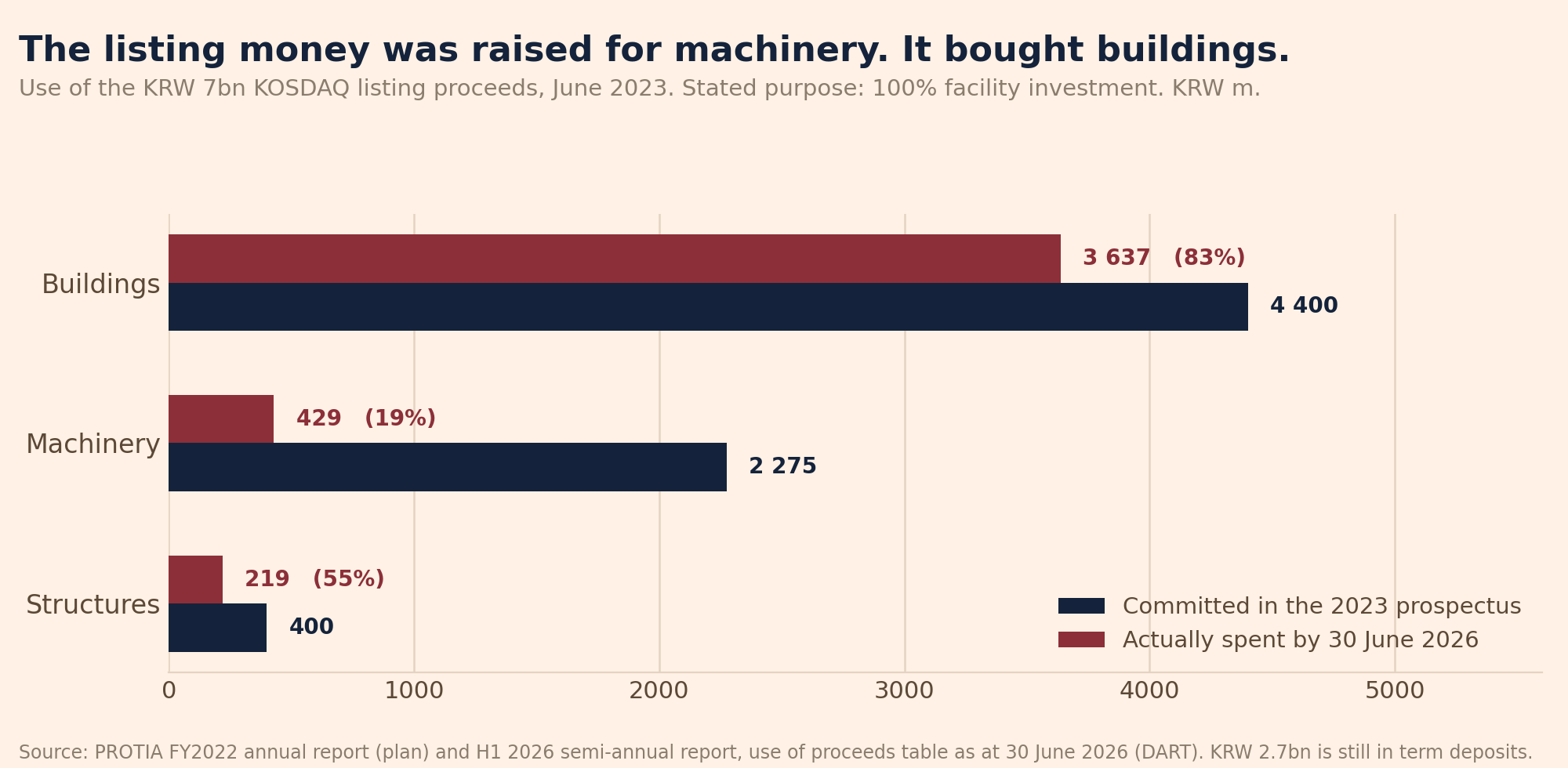
They bought the space but not the machines. The 2023 listing raised ₩7bn for facility investment, earmarked ₩4.4bn for buildings and ₩2.3bn for machinery. Three years on, the buildings are at 83% of plan and the machinery at 19%, with ₩2.7bn still sitting in term deposits. The buildings are units inside the tower PROTIA already occupies, an apartment-type factory where floors are sold one at a time. The first purchase replaced a lease it had been paying.
Two more purchases in 2025, ₩1.79bn, are booked as investment property and were made, in the company’s own words, to grow assets and earn rent. The tenant came with them. It is Mitsubishi Electric Automation Korea, whose Korean head office occupies floors seven to nine of the same block PROTIA sits in. No filing gives an address for any of this, but the two companies publish the same one. So the investment property looks like more of the floors around PROTIA’s own factory, earning 3.4% gross and 2.5% net until the company needs them. Four of the six board meetings in 2025 had a property purchase on the agenda; none was about equipment. One line sums it up. PROTIA owns ₩8.5bn of land and buildings and ₩267m of production machinery. That small amount of machinery turns out ₩17.7bn of kits a year.
The warehouse keeps filling up. Inventory has gone from 235 days of sales in 2023 to 304, then 321, and now 386 days. It grew another ₩2.1bn in the June half alone. Inventory valuation has been the auditor’s one flagged concern for three years running, and it is the reason the profits have not turned into cash. One detail I found: the fire policy covers ₩5.07bn against ₩10.8bn of stock and equipment.
There is an innocent reading of all this: 123 people, a three-person finance team, no investor relations. Sloppiness is likelier than anything worse. It is still what the discount pays for, and with insiders on 42.6% the free float is small enough that it can persist.
The verdict
The moat is real. A patent in six countries, extra allergens that cost almost nothing to add, and readers in nine of Korea’s ten biggest labs that take nothing but PROTIA strips. Add 1% global share in a market heading for $13bn and you have a fast grower with a real edge, at eleven times trailing operating profit and eight times this year’s estimate.
What comes with it is a management team that has bought the floor space and not the machines to fill it.
One thing on the other side. The 2023 listing priced at ₩4,500, which was below the strike price of nine separate employee option grants. The people who set those prices thought the company was worth a good deal more.
So: a business with a real edge, run by people who buy the floors faster than they buy the machines, at eleven times operating profit. Even if this year misses badly, the multiple barely moves. That is what a cheap stock looks like. The edge is what you are buying. The management is what the discount pays for.
This is the research I do: Korean and Japanese small caps that almost nobody writes about in English. If this one was worth your time, i-Scream Media and Hyundai Corporation Holdings get the same treatment.
Sources. PROTIA / ProteomeTech (프로티아, KOSDAQ: 303360) filings on DART: annual reports FY2022 to FY2025 and the H1 2026 semi-annual report (12 Aug 2026). All twelve-month figures are FY2025 plus the June 2026 half minus the June 2025 half, from note 26 (revenue by region and cost of sales), note 11 (inventory) and note 12 (property). Use of listing proceeds as at 30 June 2026 from section X of the semi-annual report. Patent and competitor workarounds from the FY2025 annual report, section II. Kiwoom Securities estimates, market share and the CE IVDR timing from the 16 June 2026 note via Infostock Daily and Seoul Economic Daily. Animal segment growth and the 176-allergen count from the company release of 15 July 2026 and Electronic Times, 31 March 2026. CEO revenue targets from Pharm Edaily, 13 November 2024, and Electronic Times, 31 March 2026. Market data as of 27 August 2026, share price ₩4,955, ₩1,414 to the dollar.
How I work. I read the Korean filings myself. AI helps me with translation and with checking the arithmetic. Every judgement, model and conclusion here is mine.
Disclosure. Assume I own shares in every company I write about, and read accordingly. I don’t disclose individual positions or sizes.
Disclaimer. This is analysis for discussion, not investment advice, and not a recommendation to buy or sell anything. I’m not your adviser. The figures come from primary filings but I make mistakes, so check them yourself before you act. Micro caps carry real liquidity and volatility risk, and you can lose your money.
How does someone invest in something like this? Do you have a write-up for the normies?