


Greens Co. (株式会社グリーンズ, TSE: 6547) is the kind of company that never makes headlines. A family-run hotel operator from Yokkaichi in Mie prefecture, central Japan’s unglamorous industrial coast, not Tokyo or Osaka, running mid-market hotels near train stations. It sits on the TSE Standard market and is also quoted in Nagoya, though almost all the volume goes through Tokyo. And yet, nine months into its current fiscal year, it has quietly put together one of the strongest stretches in its history.
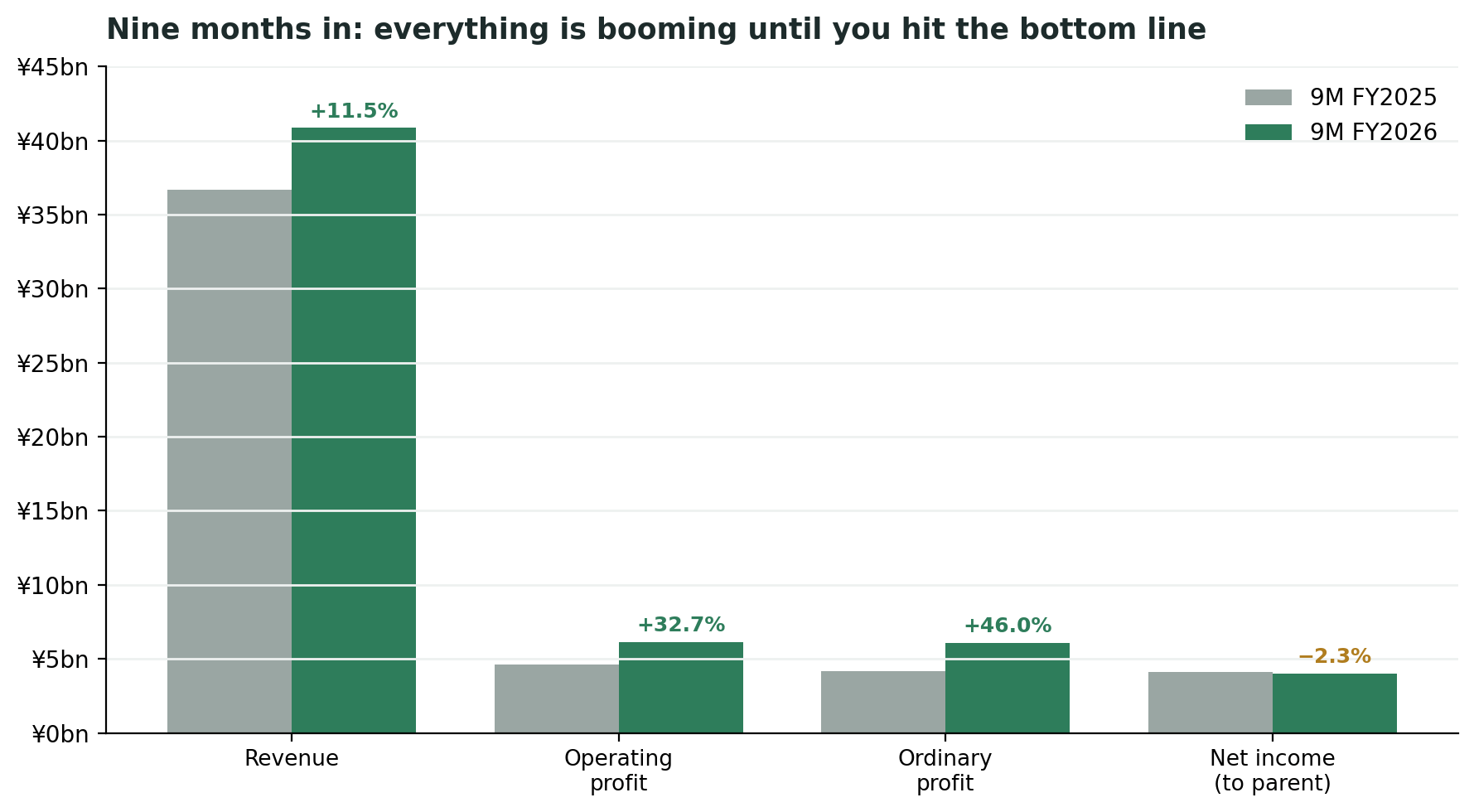
You wouldn’t know that from the number most screeners show you. Greens closes its books at the end of June, so the first three quarters run from July 2025 to March 2026. Through those nine months revenue is up 11.5% and operating profit is up nearly 33%. By every measure of how the actual business is doing, things are going extremely well. And yet reported net income is down 2.3%.
That gap is the whole story. It’s a moment where accounting tells you something that has almost nothing to do with the business — and reading past the top line pays off.
Who Greens Co. actually is
Greens was founded in the 1950s and is still effectively controlled by its founding family: the top two holders (Shinryoku Co. at ~18% and TM Co. at ~16%) plus president Yuya Muraki personally (~5%) form a commanding block. This is a regionally rooted, owner-operated business that happens to be listed.
What lifts it above the average regional hotelier is one contract. Greens has been the exclusive master franchisee for Choice Hotels International (NYSE: CHH) in Japan since 2003, the American giant behind Comfort Inn, Comfort Suites, Quality Inn and the Ascend Hotel Collection. In Japan, the whole Comfort ecosystem runs through Greens.
The portfolio splits cleanly into two:
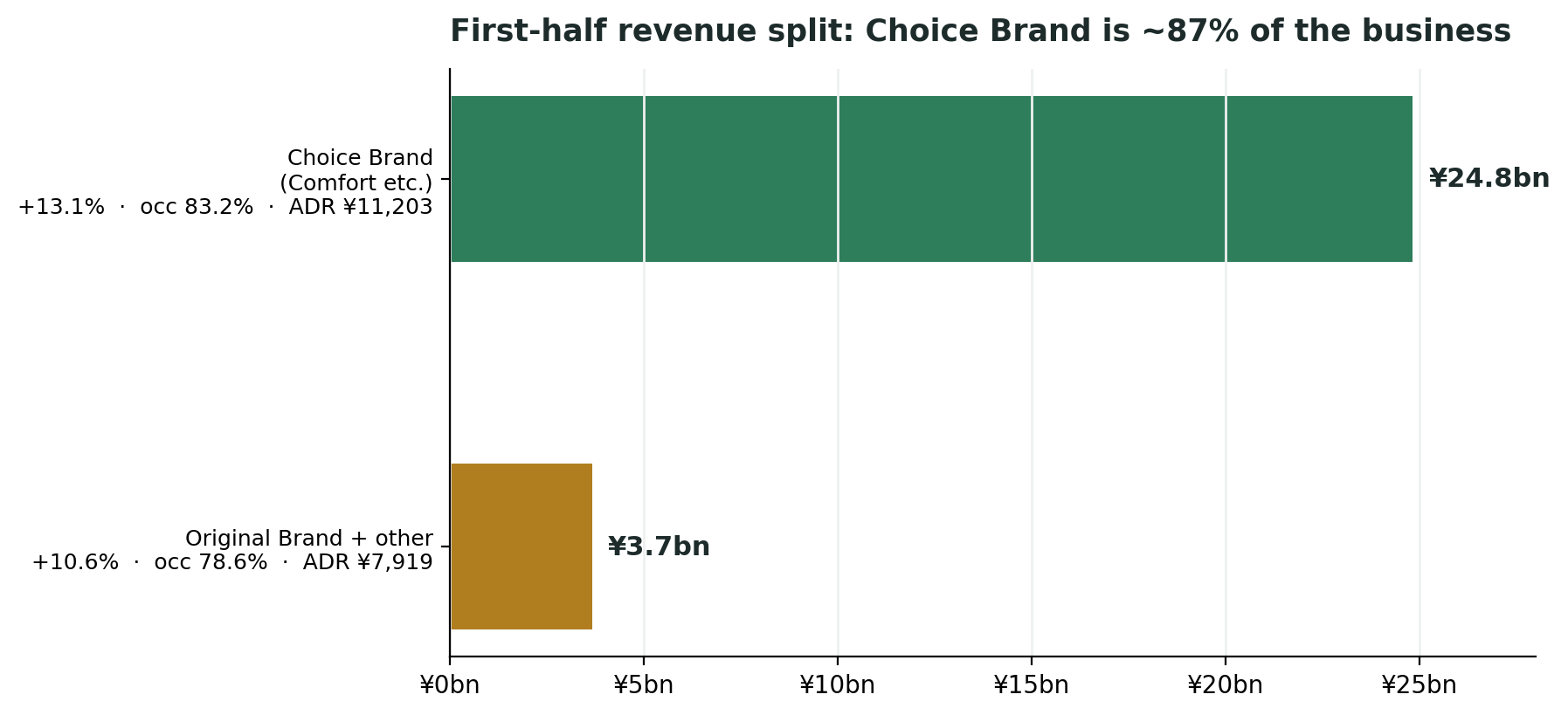
Choice Brand (チョイスブランド) — limited-service, accommodation-focused hotels, mostly Comfort Hotels clustered near major railway stations and built for efficiency. This is the engine: roughly ¥24.8bn of ¥28.5bn in first-half revenue, about 87% of the business.
Original Brand, marketed as Greens Hotels (グリーンズホテルズ) — full-service regional hotels with banquet halls, restaurants and wedding facilities, concentrated in Mie and the wider Tokai region, under names like Hotel Econo and Green Hotel. Smaller and lower-margin (a banquet takes far more labour than a check-in desk), but it’s the sticky, community-driven local anchor.
As of the December 2025 interim, the group ran about 120 hotels and ~16,900 rooms.
Greens Co.'s operating numbers: occupancy and ADR both rising
Strip out the accounting noise and what’s left is a textbook recovery firing on the two cylinders that matter in hospitality: occupancy and rate.
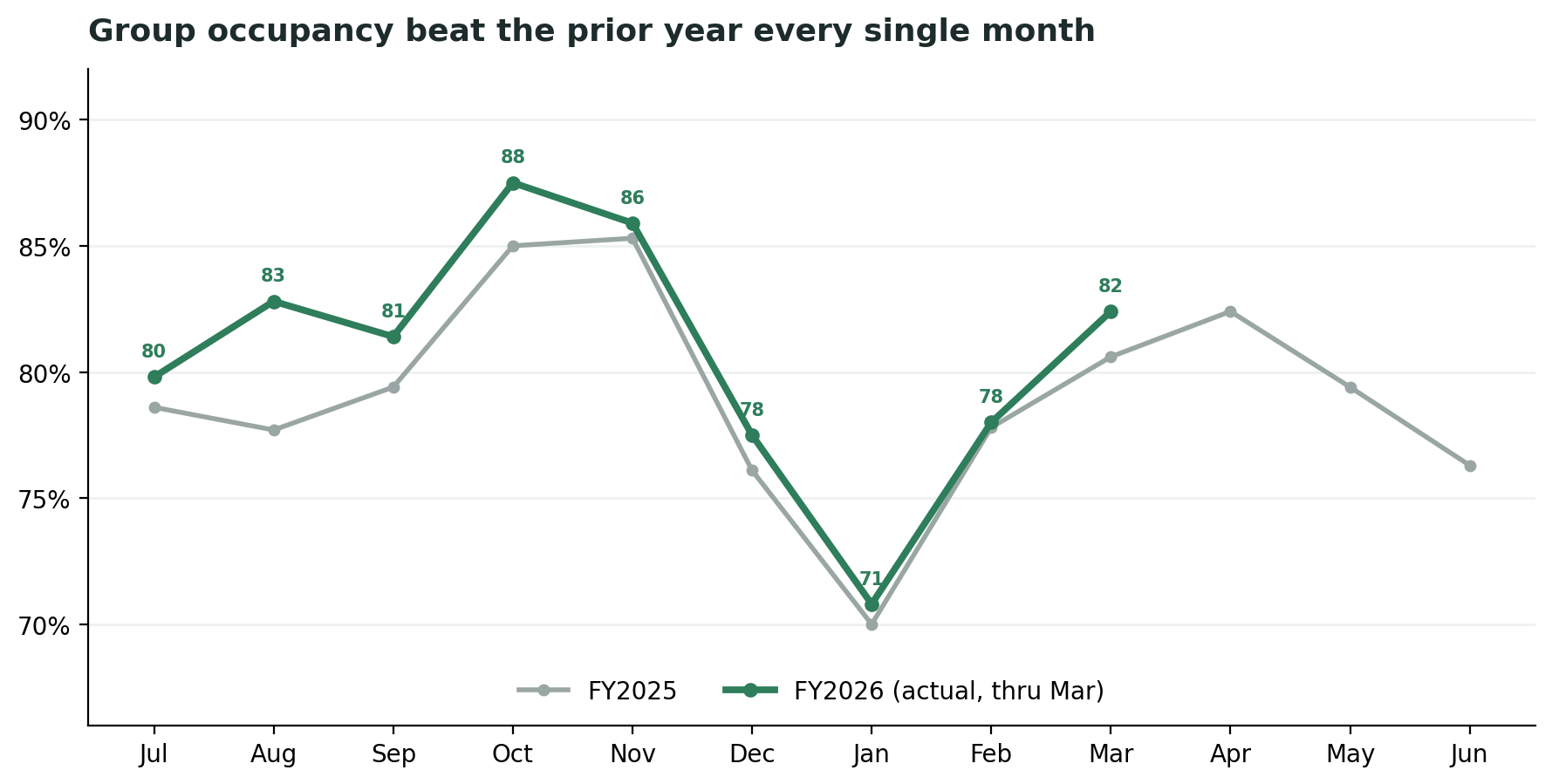
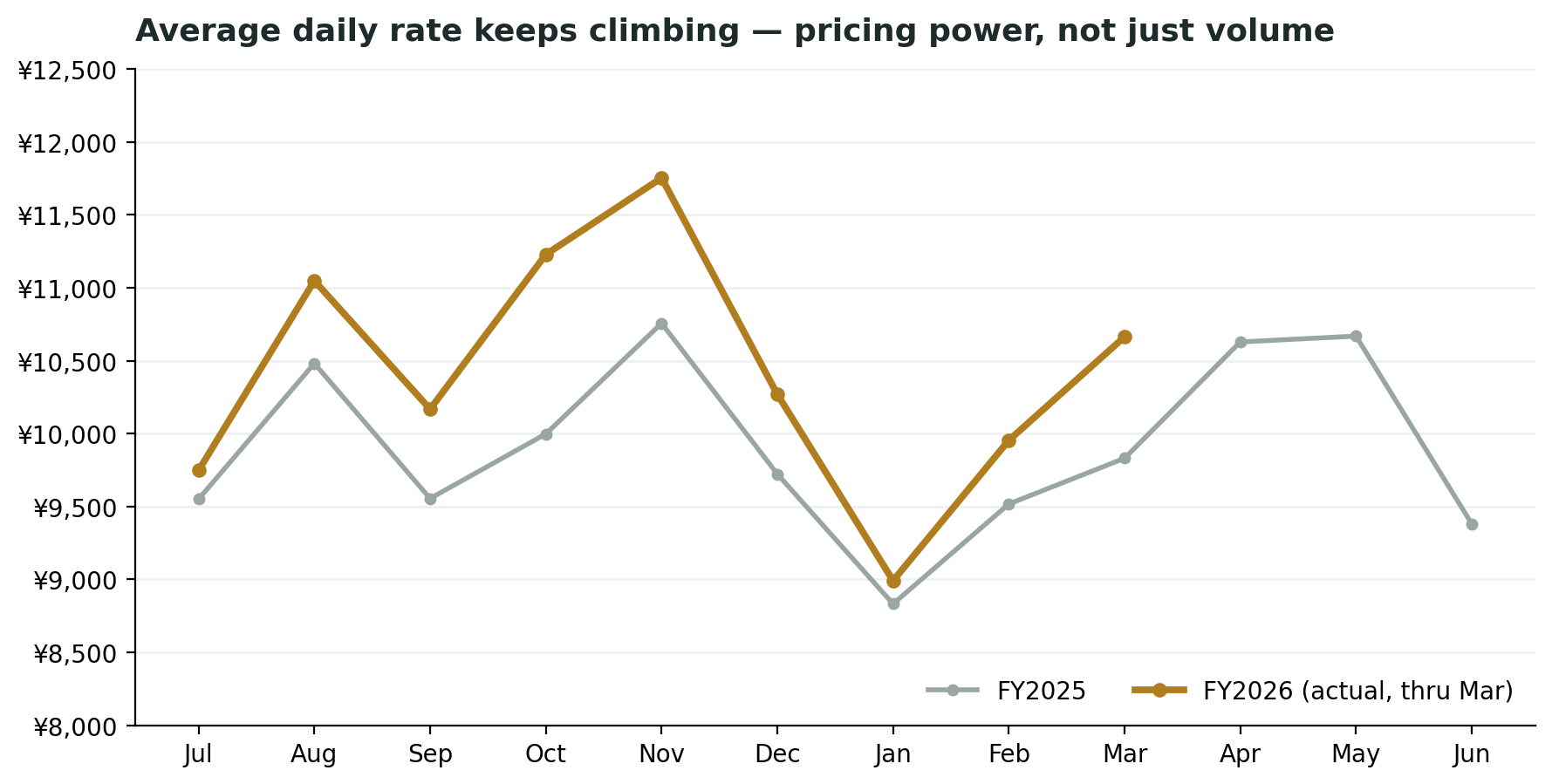
Across the most recent quarters, group occupancy and average daily rate (ADR) beat the prior year in every single month — and crucially, they’re doing both at once. They aren’t trading price for volume; they’re getting more of each. For the first half, group occupancy hit 82.5% (+2.1 points) with ADR at ¥10,724 (+7.0%).
That ADR line is the one I’d stare at. Rising rates alongside rising occupancy is the signature of real pricing power — demand outrunning supply — not a discount-driven fill.
By brand for the first half: Choice Brand grew revenue +13.1% (occupancy 83.2%, ADR ¥11,203); Original Brand +10.6% (occupancy 78.6%, ADR ¥7,919), with its operating profit up nearly 75% on the back of better rates. And they kept investing into the strength, opening two new-build hotels: Comfort Hotel Mito (Ibaraki, November 2025) and Comfort Hotel ERA Sapporo Kitaguchi (Hokkaido, December 2025).
Why Greens Co.'s net income is falling while operating profit rises
Taxes, specifically the end of a tax holiday.
Like many Japanese hotel companies, Greens went through a brutal pandemic stretch and built up loss carryforwards: past losses that shelter future profits from corporate income tax. For the last few years it has been profitable while paying almost nothing in tax, because those old losses absorbed the bill. In the prior-year nine-month period the tax line was negligible.
This year the carryforwards ran out, and the tax line jumped by well over a billion yen. That single swing is the entire reason a ~33% rise in operating profit becomes a 2.3% decline in net income. It’s the same mechanism behind the full-year guidance, which still calls for net income down 31.6% even as revenue grows to ¥53.2bn.
Be clear about what this isn’t: not margin compression, not weak demand, not a cost blowout. It’s the business graduating to a normal tax rate — painful optically, neutral-to-healthy in substance. A company that pays full tax is usually one that has finished cleaning up its past. (And notice the year-on-year drag is already easing: net income was down 8% at the half, down only 2.3% by the nine-month mark.)
The detail that jumps out: nine-month profit above the full-year forecast
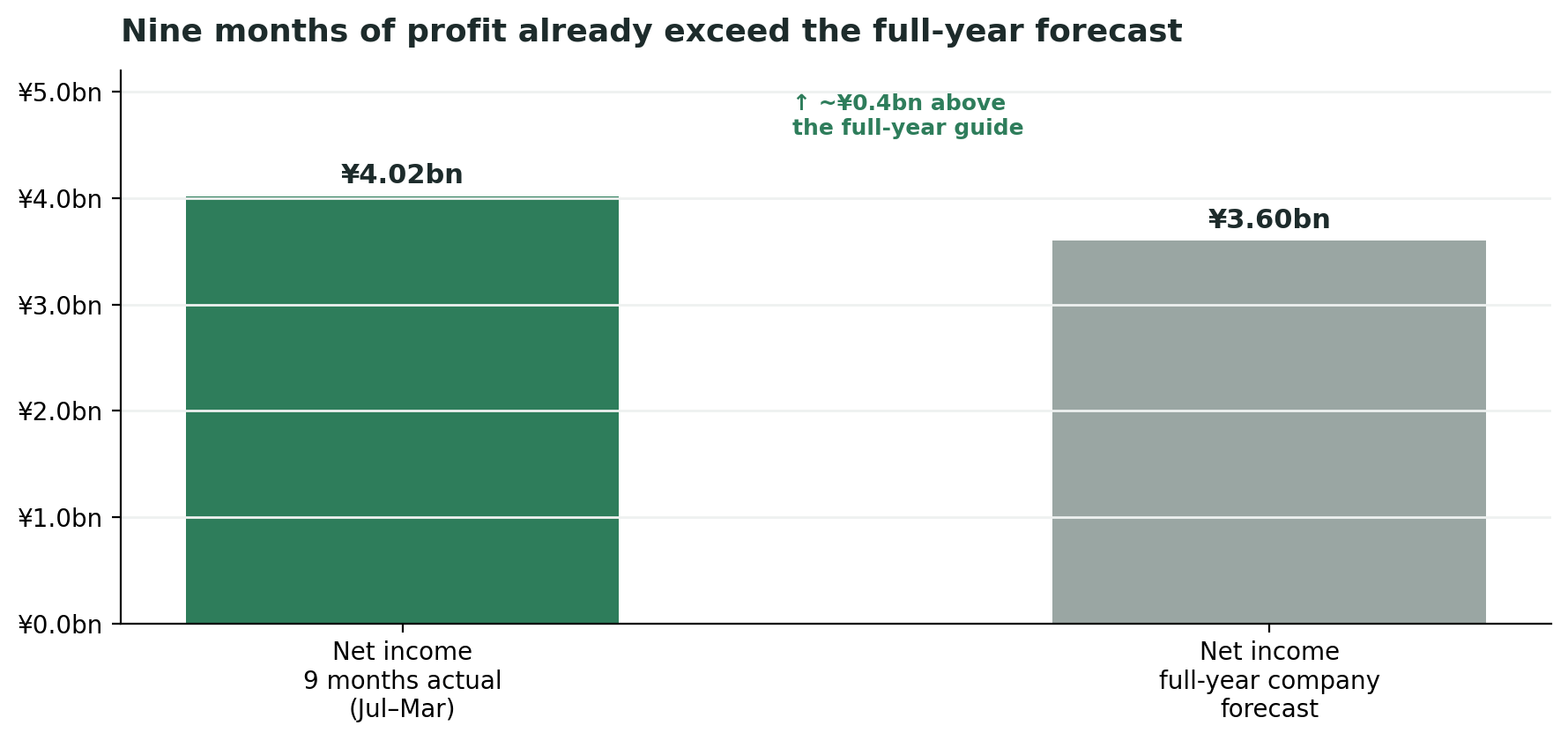
Here’s the kicker. Net income for the first nine months already came in at ¥4.02bn — comfortably above the company’s ¥3.6bn full-year forecast. In other words, on the official numbers the firm is guiding to a small net loss in the final quarter.
There are a couple of innocent explanations — interim tax is estimated using a full-year effective rate, so the heavier tax true-up can land late in the year, and management tends to be conservative. But either way, it’s a flashing signal: this is a business whose underlying earnings are running well ahead of its own published expectations. Watch for a guidance upgrade.
Greens Co.'s balance sheet and the DBJ preferred shares
The clean-up shows elsewhere too. Total assets have grown to ¥37.3bn (from ¥29.4bn a year earlier) as the new hotels come online, while the equity ratio improved to 36.8% from 34.6%. First-half operating cash flow was a healthy ¥5.5bn; the company is repaying long-term debt and still raising its dividend, from ¥35 to a forecast ¥40 per share.
One artifact of the COVID era remains on the cap table: a small slug of Class A preferred shares held by the DBJ Food & Lodging Support Fund, the state-backed Development Bank of Japan’s rescue vehicle. They carry a 4.0% preferred dividend, and under the agreement DBJ generally can’t force redemption until June 30, 2028. A modest overhang — and a reminder of how close the sector came to the edge — but increasingly one the company looks set to simply grow out of.
The cloud on the horizon: China
No Japanese tourism story is complete without the inbound question. Calendar 2025 was a record 42.68 million foreign visitors. But the back half of the calendar year wobbled: nationwide accommodation nights fell year-on-year in both November and December 2025, driven by a sharp drop in Chinese travelers amid worsening Japan–China relations.
Here Greens has an unusually comfortable seat. Management puts Chinese guests at only about 4% of its total — far below the inbound market overall, where Chinese visitors have historically been close to a fifth of arrivals. (Outside analysts peg China-linked revenue a touch higher, around 6–8%, and note management has been shifting marketing spend toward North American and European source markets.) Just as important, roughly half of Greens’ demand comes from domestic business travelers — the steady, off-peak, recession-resistant base that doesn’t care about diplomatic spats and keeps the station-side Comfort Hotels ticking over regardless of inbound leisure swings.
That mix — a domestic, business-traveler floor under an inbound-leisure upside — is arguably the most attractive thing about the model, and exactly what should cushion the China softness likely to surface in the coming prints.
What I’m watching
Does the ADR line keep rising? Pricing power is the thesis. The day occupancy gains start coming only from discounting is the day this gets less interesting.
A guidance upgrade. Nine-month profit is already above the full-year forecast. Either Q4 carries a real tax true-up, or the guide gets raised.
How hard China actually bites. The ~4% self-reported exposure gets tested in the upcoming numbers; a small, manageable dent confirms the domestic-floor story.
The 2028 preferred-share clock. An early redemption of the DBJ preferreds would be a clean signal that the COVID chapter is formally closed.
Greens does one thing — running mid-market hotels near train stations — and is doing it well into a strong demand cycle. The bottom line is temporarily misleading. The business underneath it is not.
I have covered several other overlooked Japanese and Korean micro caps, including KIYO Learning (TYO: 7353), i-Scream Media (KOSDAQ: 461300) and Total Soft Bank (KOSDAQ: 045340).
Sources. Greens Co. (株式会社グリーンズ, TSE & Nagoya: 6547) filings on EDINET and the company’s results releases for the first quarter, interim and third quarter of the year to June 2026. Inbound visitor and accommodation data from the Japan National Tourism Organization and the Japan Tourism Agency. Market data as of 5 June 2026.
How I work. I read the Korean and Japanese filings myself. AI helps me with translation and with checking the arithmetic. Every judgement, model and conclusion here is mine.
Disclosure. Assume I own shares in every company I write about, and read accordingly. I don’t disclose individual positions or sizes.
Disclaimer. This is analysis for discussion, not investment advice, and not a recommendation to buy or sell anything. I’m not your adviser. The figures come from primary filings but I make mistakes, so check them yourself before you act. Micro caps carry real liquidity and volatility risk, and you can lose your money.