

A Japanese Exam Company Selling For Less Than The Cash In Its Bank
An asset play and a fast grower in the same ticker, which is not supposed to happen. Third in my series on listed education businesses in Asia.

The first two were Korean. I-Scream Media sells lesson software to 93 percent of Korean primary school teachers. IB Kimyoung earns a 150 percent return on capital and yields 15 percent. Both are small, both are ignored, and both sell something unglamorous to people who need a qualification.
This one is Japanese and quieter than either. KIYO Learning (TYO: 7353) sells online courses that prepare you for professional exams. Bookkeeping, real estate broker, labour consultant, tax accountant. The sort of thing an office worker studies on the train because it gets him a promotion. The whole company is worth 3.8 billion yen and no analyst covers it.
Two things make it interesting. It holds more cash than it is worth. And the accumulated deficit that has kept its dividend line blank since 2010 is finally gone.
The business
Japan takes professional licences seriously. About 550,000 people sit the bookkeeping exams each year. In 2025, 245,000 sat the real estate broker exam and 18.7 percent passed. Another 43,421 sat the labour consultant exam and only 2,376 got through. These exams gate careers, and people pay for them out of their own pocket.
The old way to prepare is a classroom school. TAC, LEC and Ohara charge around 200,000 yen. KIYO charges 59,400. It has no classrooms, no branches and no sales floor. You get video cut into three minute chapters, a large question bank, and an AI layer that plans your revision and predicts your score. The state runs the exam and does not care where you studied, so the cheap course wins on arithmetic.
Students pay the whole fee up front, and the accounting rules make KIYO spread that money across the months they keep access. Cash in January, revenue all year. That is why the company reports a loss every spring while the bank balance climbs.
The asset play
Peter Lynch sorted stocks into six kinds. The rare ones belong to two kinds at once, and this is one of those. Start with the balance sheet.
At 550 yen a share the company is worth 3,778 million yen. In March it held 3,606 million of cash against 450 million of debt. So the business itself costs you 622 million.
Now the fair objection. KIYO sits on 2,517 million of tuition it has been paid but not yet earned, and it still owes those students a service. So price the service. Cost of sales is 595 million of outsourced content production, 115 million of studio staff and 94 million of communications. The first two build new courses. Only the last, 1.9 percent of revenue, is what it costs to let a student who already paid press play on a video that already exists. Apply that to the prepaid balance and you get 47 million. Call it 60.
So you pay 682 million for a business that earned 304 million last year and is guided to earn 400 this year. It gets better if you wait.
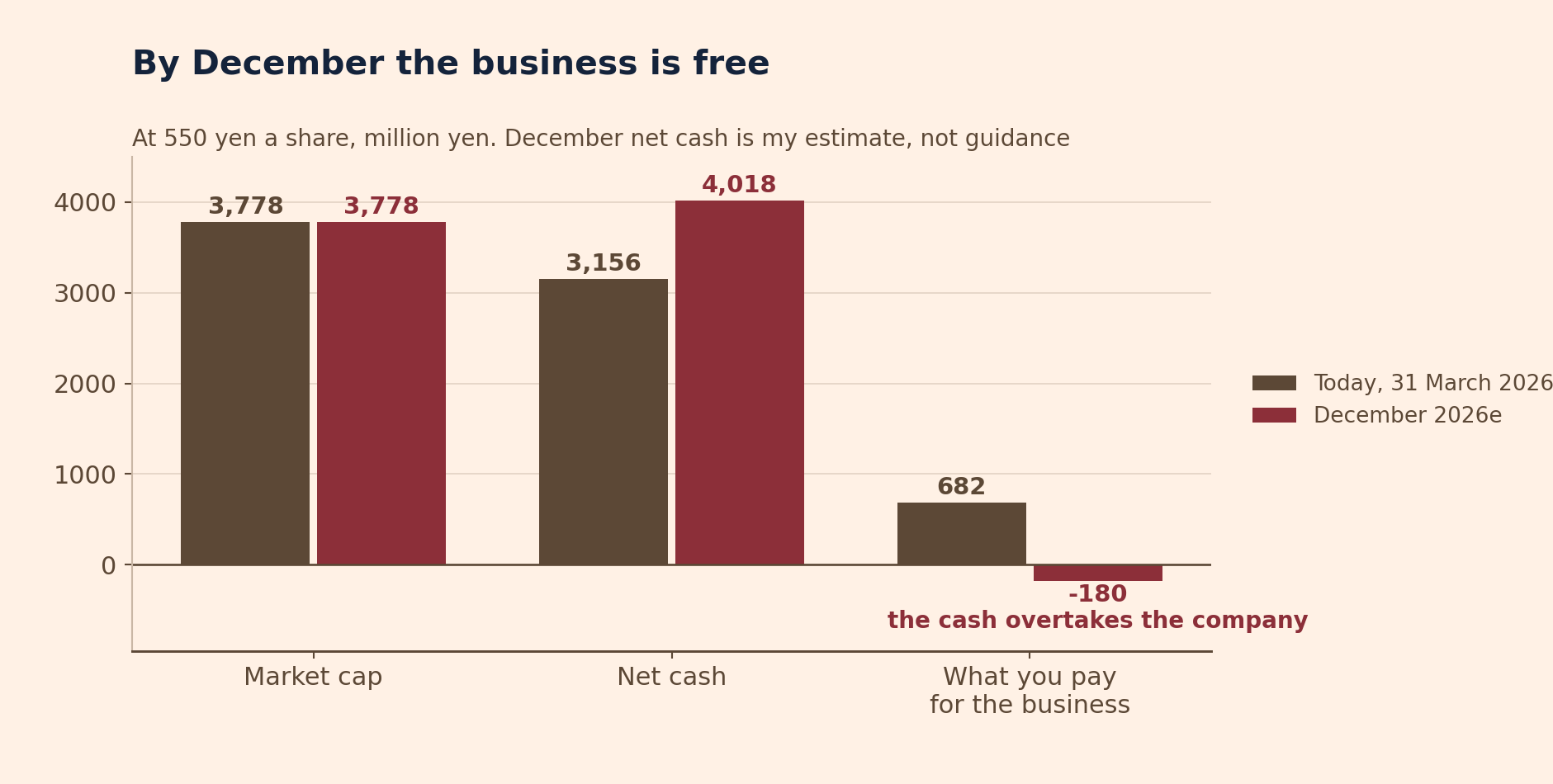
Guidance implies 330 million of net profit. Add back depreciation, take out capex, assume the prepaid balance adds 100 million instead of last year’s 365, and allow for the leakage in the 2025 accounts. That builds about 385 million of cash. Net cash reaches roughly 4,018 million by December, or 585 yen a share.
You are paying 550. Take the cash off the price and by New Year you are paying nothing for the business.
The fast grower
A cheap balance sheet on a bad business is a trap, so look at the business.
Revenue went from 2.3 billion in 2021 to 5.0 billion last year and is guided to 5.8 this year. KIYO owns almost nothing to produce it. Fixed assets, software, content and receivables come to about 615 million yen, and on that it earned 304 million of operating profit. A 49 percent return.
It does not even fund those assets. The students do. The 2,517 million of prepaid tuition is larger than everything the company owns, so the customers supply the working capital a year early. KIYO has never asked shareholders for money because it has never needed any. Capital employed is negative, so there is no clean return on capital number to quote, but growth here is close to free and that is rarer than a high margin.
There’s one catch that came up three months ago, but it doesn't necessarily mean anything bad for the business.
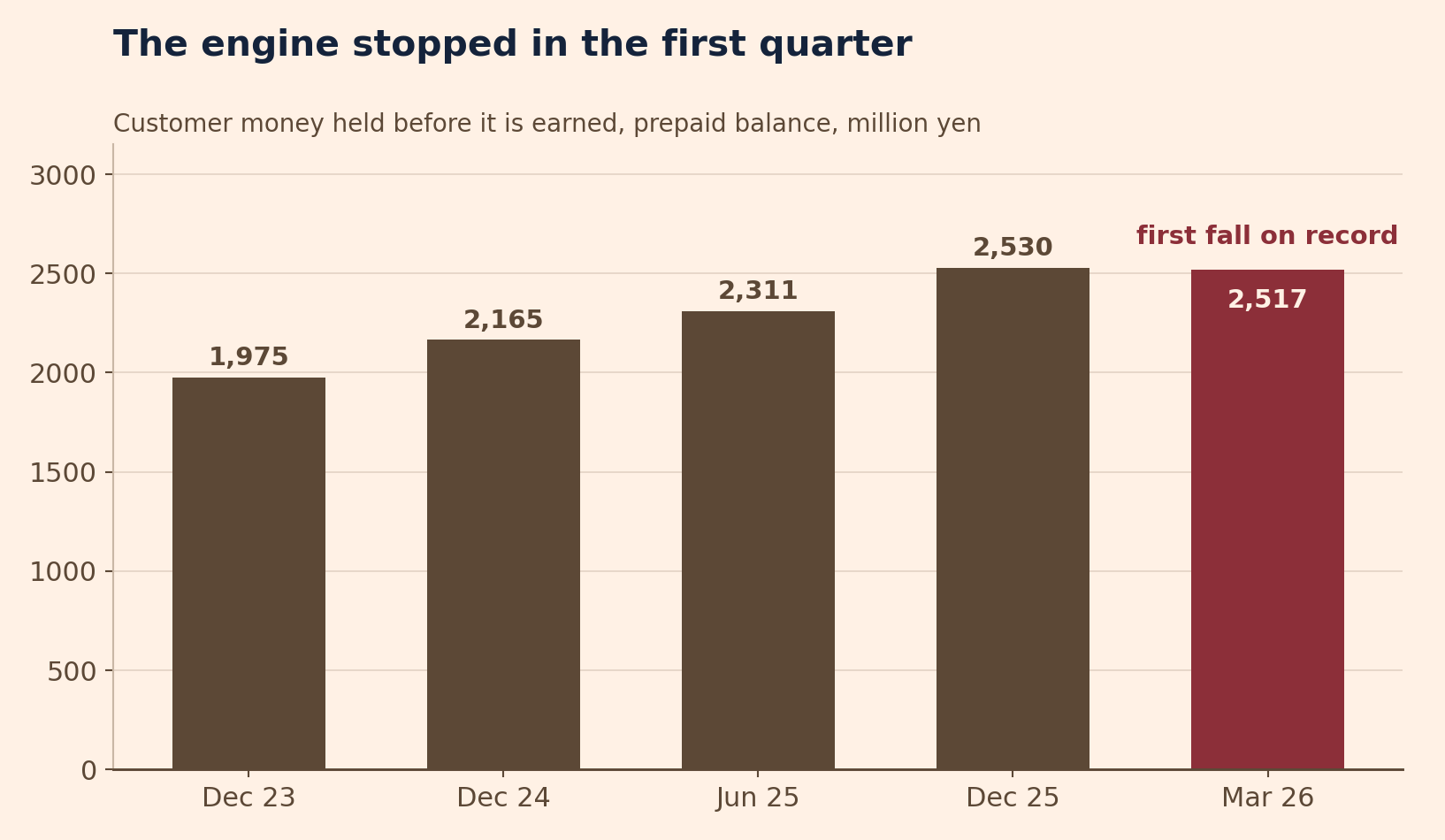
Management is pushing shorter courses because they turn into revenue faster. That drains the prepaid balance. It grew 145 million in the first half of 2025 and 141 million in the first half of 2024. In the first quarter of 2026 it fell by 13 million, in the quarter when the January campaign runs and exam season sign ups arrive.
Revenue rose 14.6 percent and the money coming in the door did not. Some of this year’s growth is faster recognition of cash they already had. The August half year report tells you whether that is a mix shift or a demand problem.
The guidance record
I like companies that do what they said they would do.
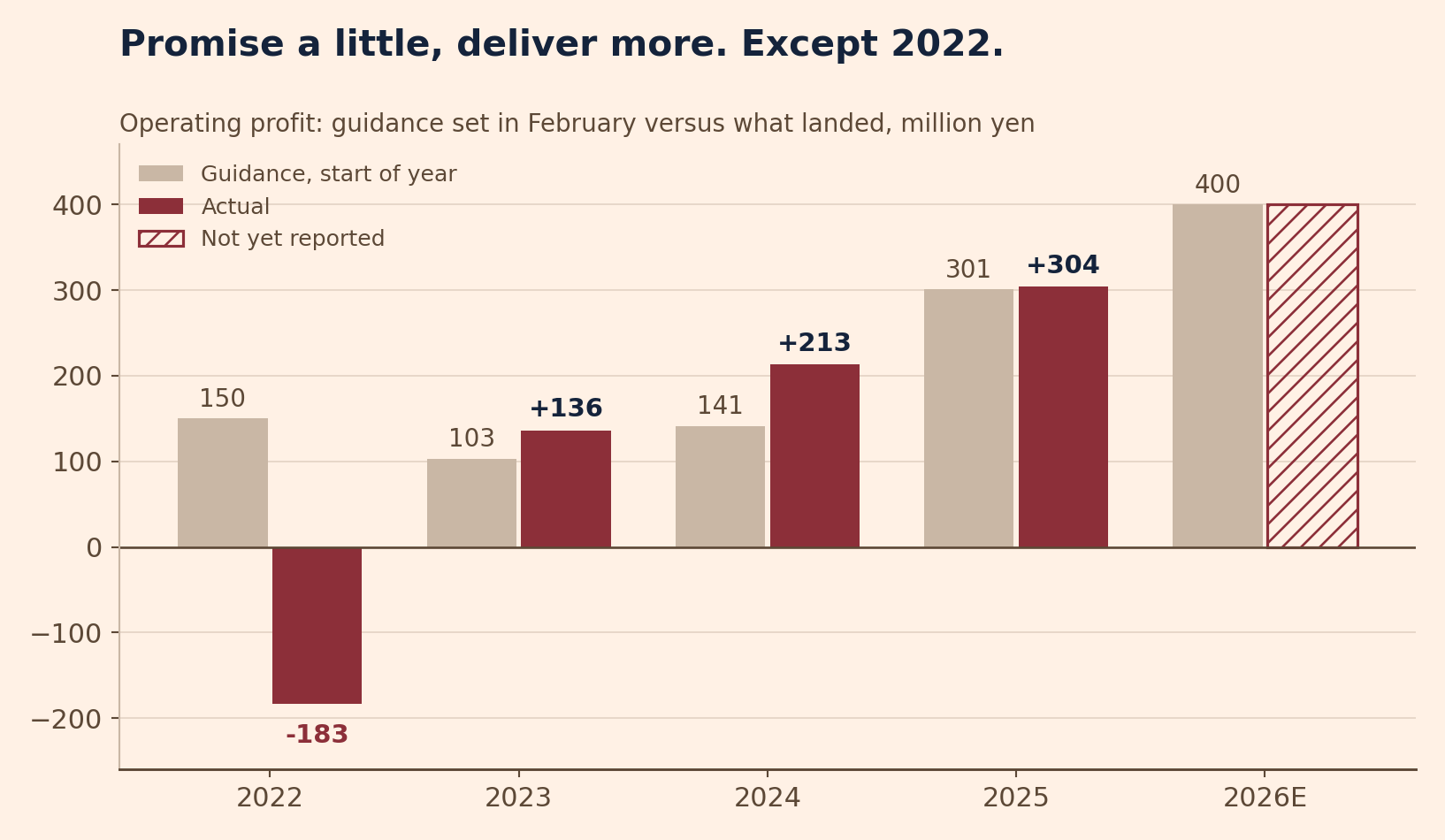
KIYO sets full year operating profit guidance every February and reports against it four times a year. The one miss was 2022, when it promised 150 million and delivered a loss of 183 after an advertising push that did not work.
One caveat. The 2024 target was easy, 141 against the 136 they had just made, and they beat it by half. The last two were not easy. They promised 41 percent more, then 32 percent more, and delivered the first. So I take this year’s 400 million seriously.
Here is my favourite number in the file.
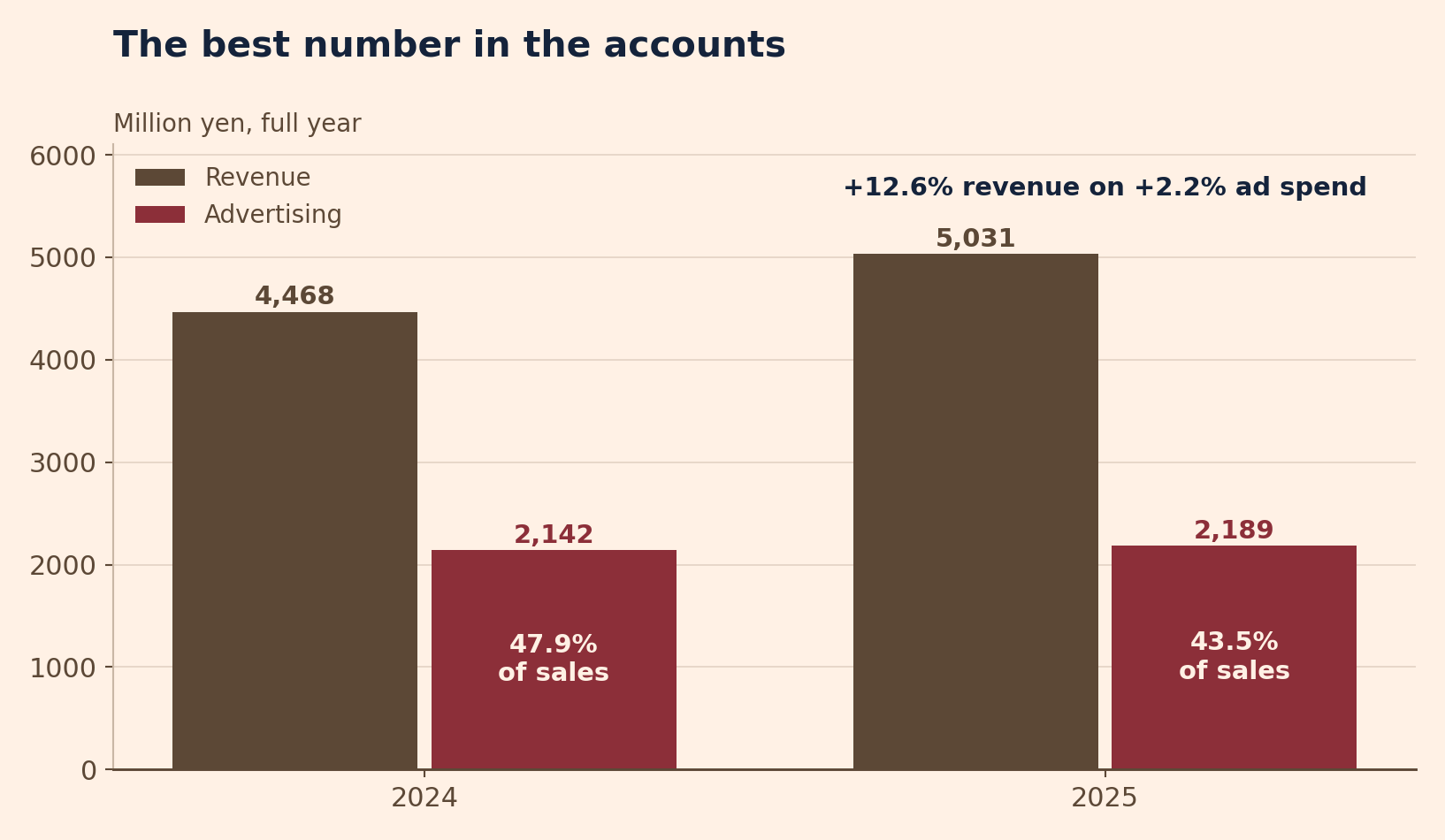
Advertising went up 2.2 percent last year. Revenue went up 12.6 percent. The ratio fell from 47.9 percent of sales to 43.5. In the March quarter the operating loss narrowed to 251 million from 313 while sales grew.
That matters because the margin is thin. Gross margin is 83 percent, which sounds like software, but 43.5 yen of every 100 goes to advertising and the operating margin is 6 percent. This is a marketing machine with a good product. The advertising ratio is the only honest scoreboard it has, and one year is not a trend.
The cash flow
Last year the business produced 726 million of operating cash flow and spent 104 million on capex. That looks like 622 million of free cash against a 682 million price.
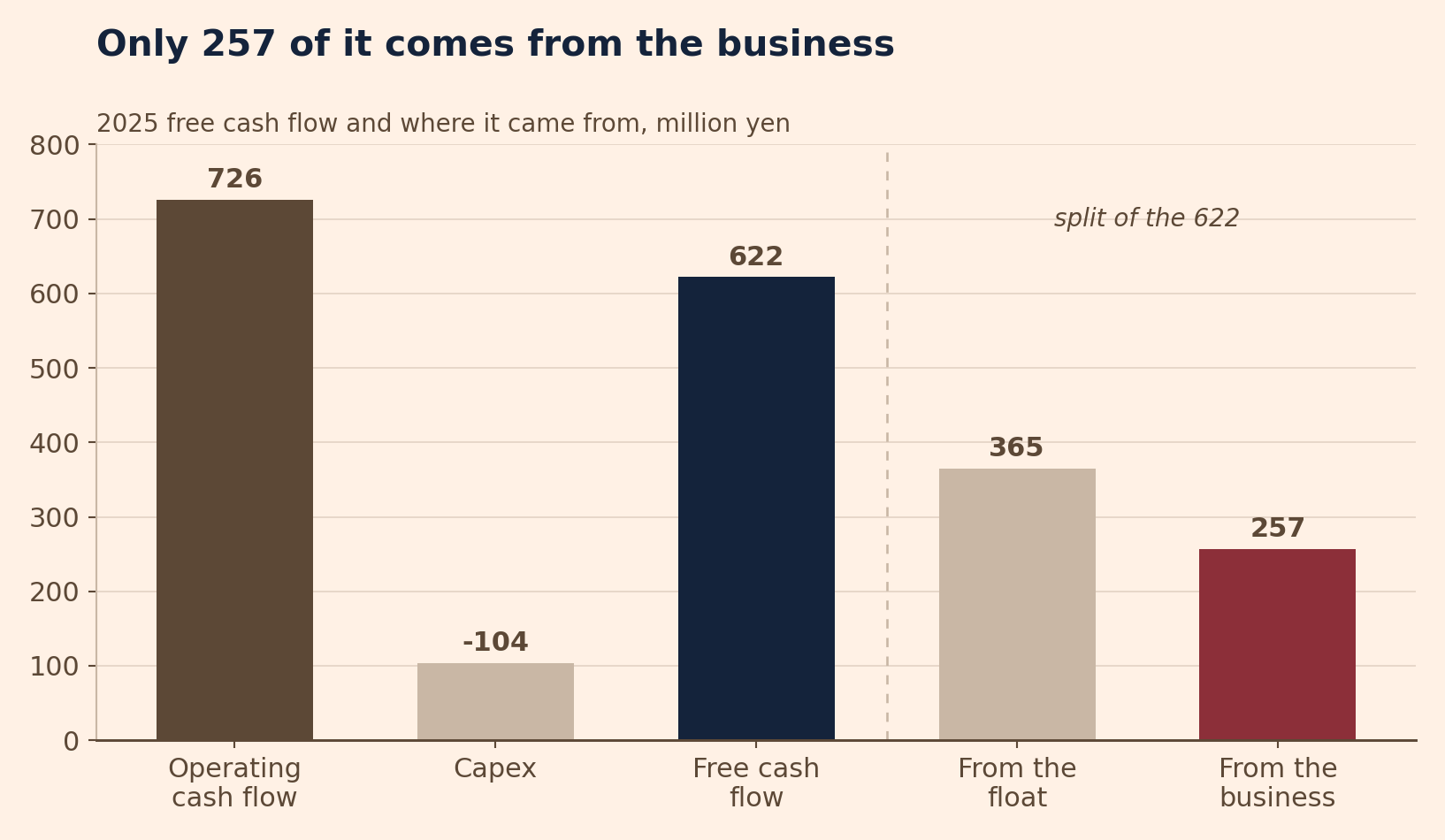
But 365 million of it is the prepaid pile getting bigger, and the pile only grows while the company does. Strip it out and the business itself produced 257 million. Still a third of the price, every year.
Old losses meant KIYO paid a 3 percent tax rate last year. Guidance shows operating profit up 32 percent and net profit up only 12. That gap is the tax bill turning up, and it widens as the old losses run out.
The founder
Takayoshi Ayabe founded the company, still runs it, and owns 40.08 percent, worth about 1,514 million yen. The two inside directors shared 40.55 million of pay last year and nobody earned over 100 million. He gets rich the same way you do. Visional, the group behind the recruiter BizReach, took its stake to 6.09 percent in February, and two more recruiters hold another 4.5 between them.
KIYO has never paid a dividend since it was founded in 2010. Japanese law caps payouts at distributable surplus, and the deficit from the loss making years kept that at zero. At December the deficit was 10.2 million yen against 330 million of guided profit, so the 2026 accounts should clear it and the board can then declare one without asking shareholders. For your information, they could have unlocked it years ago by reducing the capital reserve, but they didn't bother.
The annual report calls reinvestment the best return to shareholders, gives no date for a dividend, and says the company is weighing alliances, minority stakes and acquisitions. KIYO has no subsidiaries and has never bought a company.
My worry is not four billion yen sitting in a bank. It is a first acquisition, at that size, by someone who has never made one.
What it is worth
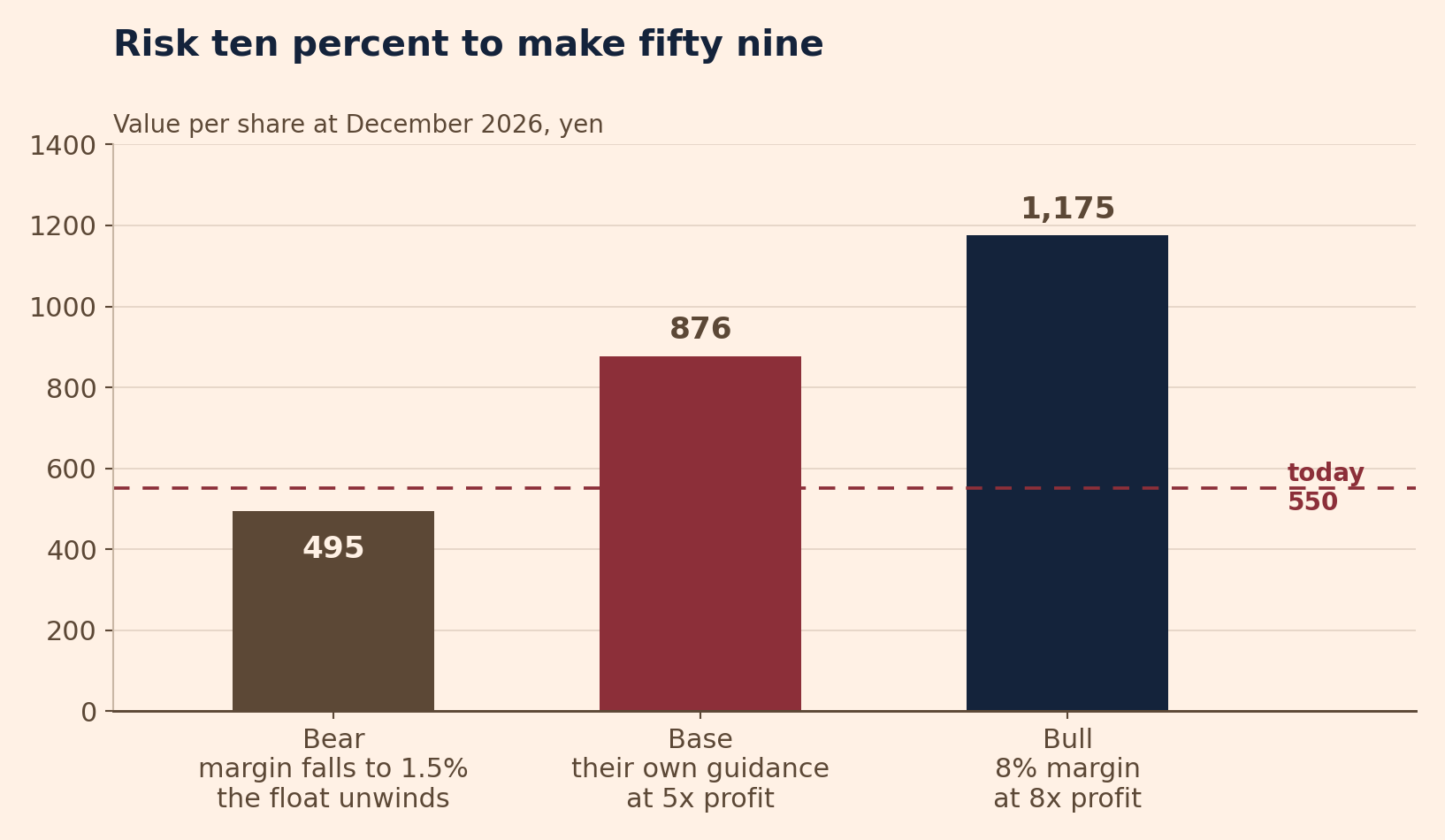
Three cases at the December year end.
Base is their own guidance. Revenue 5,800 million, operating profit 400 million. Five times that plus the net cash gives 876 yen, or 59 percent up.
Bull takes revenue to 6,200 million at an 8 percent margin, so 496 million of profit. Eight times gets you 1,175.
The bear case is the reason to own the thing. AI answers eat the search traffic, revenue stalls at 5,300 million and the margin falls to 1.5 percent. The business earns 80 million, which deserves no multiple, so give it none. The prepaid balance is six months of forward revenue, and in that world it unwinds rather than builds. Take 250 million out of it and cash goes backwards by 235 million over the year rather than forwards by 385.
Count the cash and nothing else and you get 495 yen a share. You are paying 550.
When I would sell
Three things would end it.
If the advertising ratio climbs while growth slows, the funnel is breaking. If the June prepaid balance is still stuck under March’s 2,517 million, the mix shift explanation is gone and this is a demand problem. And if they announce a large acquisition outside exam preparation, the asset play is over.
None of this is hidden. The business costs 682 million and is guided to earn 400. The bank account passes the market value in December. The founder owns 40 percent of it and has a chequebook in his hand. It sits in a Japanese filing that almost nobody reads, which is the only reason it is still there.
The half year report lands next Friday. That is when we find out whether the prepaid balance turned back up, and I will go through the numbers again in the chat group where we can discuss it.
Disclosure: I do not disclose individual positions. Assume I own what I write about and read accordingly.
Sources: KIYO Learning’s filings on EDINET, the annual report to December 2025 and the first quarter to March 2026. Course prices from studying.jp. Exam results from the administering bodies. AI helped translate the Japanese and check the arithmetic. Analysis, not investment advice. Do your own work.
Interesting, Saving for later to do more deeper dive….