


Not my usual kind of company
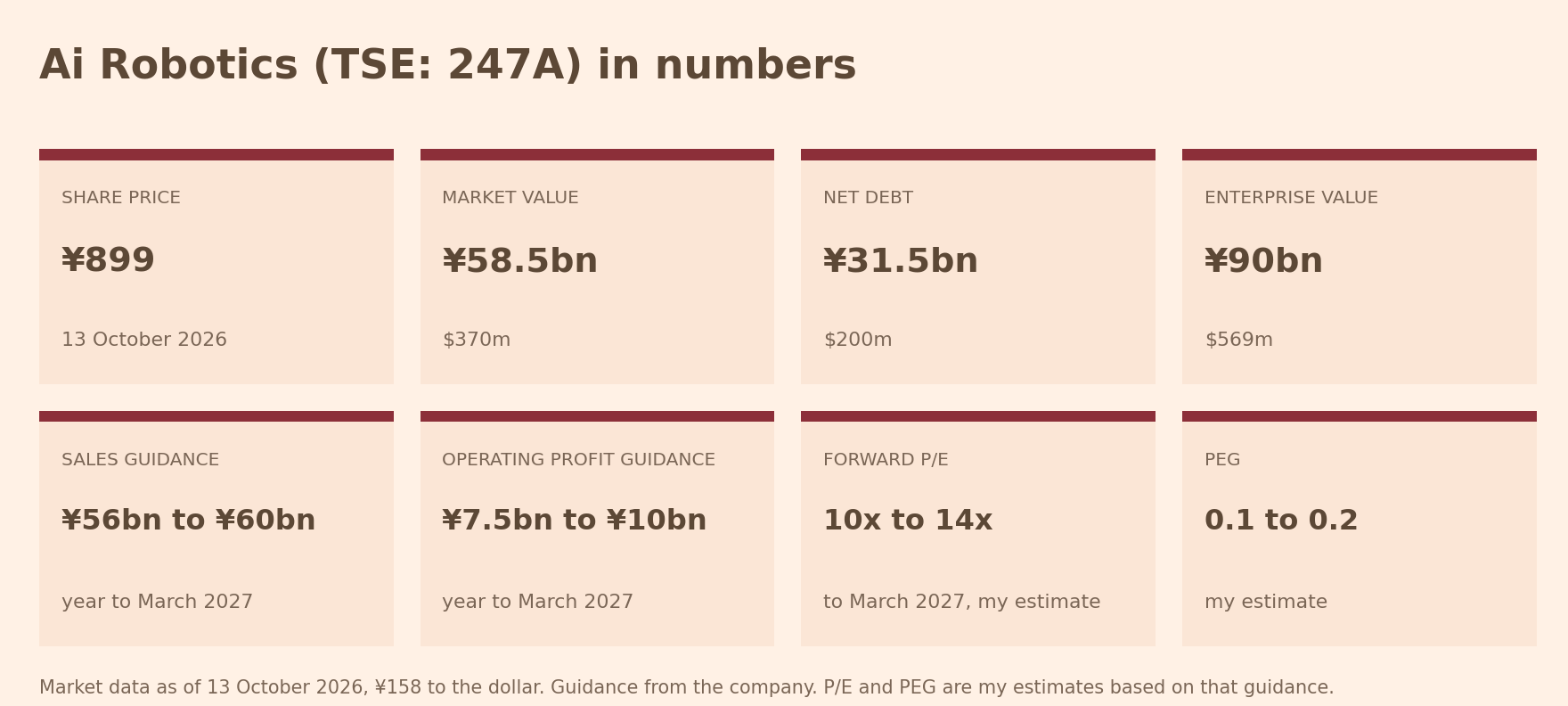
I often write about Japanese and Korean companies that nobody has covered in English before. Ai Robotics is a bit different. It publishes its results and IR materials in English, and Philipp Haas, a fund manager and Substack author, has already written it up and owns the shares in his fund. On top of that, I usually avoid AI, robotics and chip stocks, but this business is not what the name suggests.
Skincare, not robots
Ai Robotics sells beauty products made by contract manufacturers. The name comes from its own software, SELL, which it says uses AI and automation to plan products, buy online ads and forecast demand. Its skincare brand Yunth is best known for a pure vitamin C serum in single-dose capsules. Under the Brighte brand it sells hair dryers and face devices, and under Straine it sells shampoo. In April the company bought BJC, which sells eyelash serum and cosmetics through about 40,000 beauty salons.
Yunth's vitamin C serum in single-dose capsules
Brighte's Shower Dryer
Straine shampoo
Lashaddict eyelash serum from BJC
The founder says Ai Robotics can sell whatever its data shows will sell, and beauty fits best because margins are high and customers buy again. According to the company, SELL has cut the cost of acquiring an online customer from about ¥200,000 to below ¥10,000 since 2018. Last year only 36 permanent employees, plus 17 temporary staff, produced ¥29.4bn of sales at a 13% operating margin. That is more than ¥800m (over $5m) of sales per permanent employee!
The plan
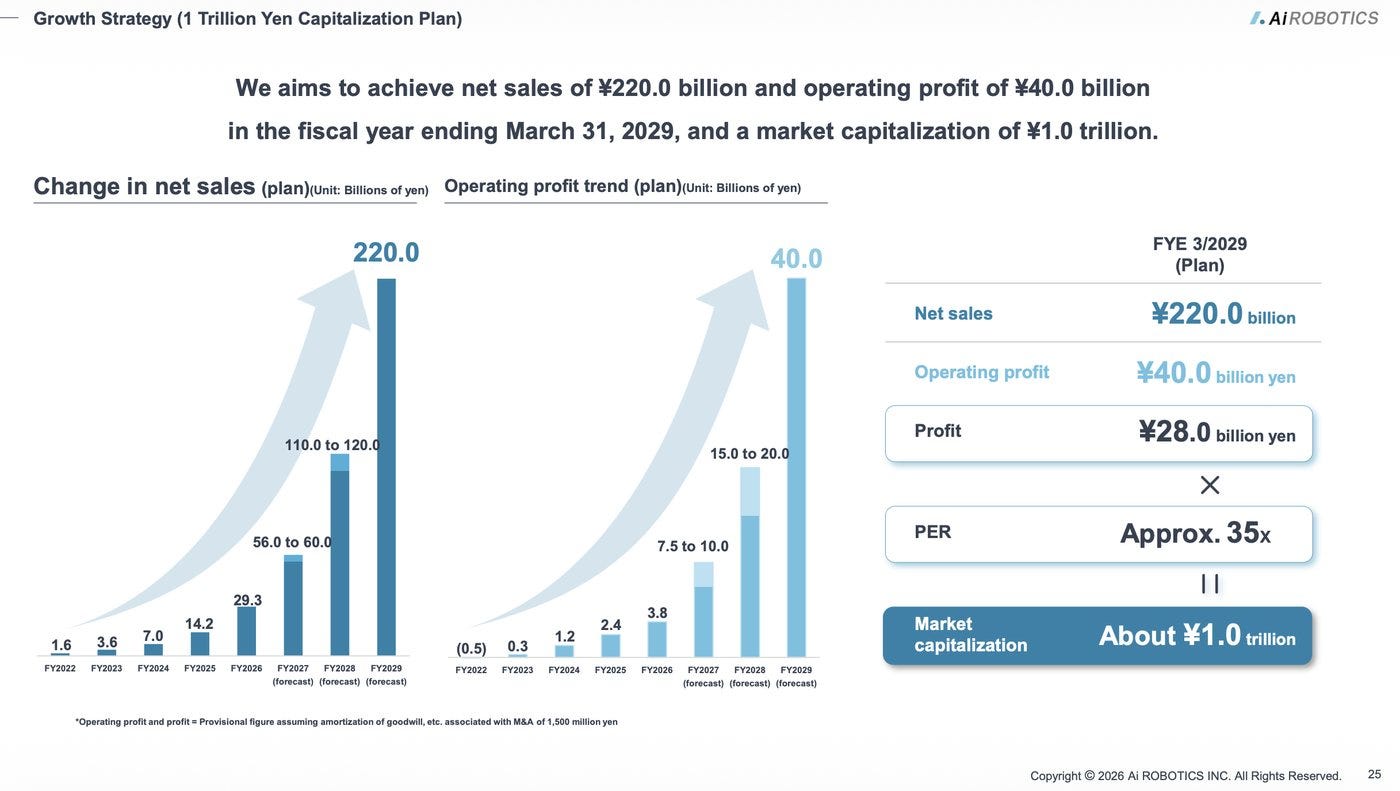
The goal is a market value of ¥1 trillion by March 2029, 17 times today’s value. To get there, sales and profit must double every year, to ¥220bn of sales and ¥28bn of net profit, and management puts that profit on a P/E of 35. Part of the growth should come from acquisitions and from new businesses the company starts itself. Its role model is APR, the Korean owner of Medicube, which reached that value with similar revenue but makes 92% of its sales abroad, compared with 7.4% at Ai Robotics.
From online to shops
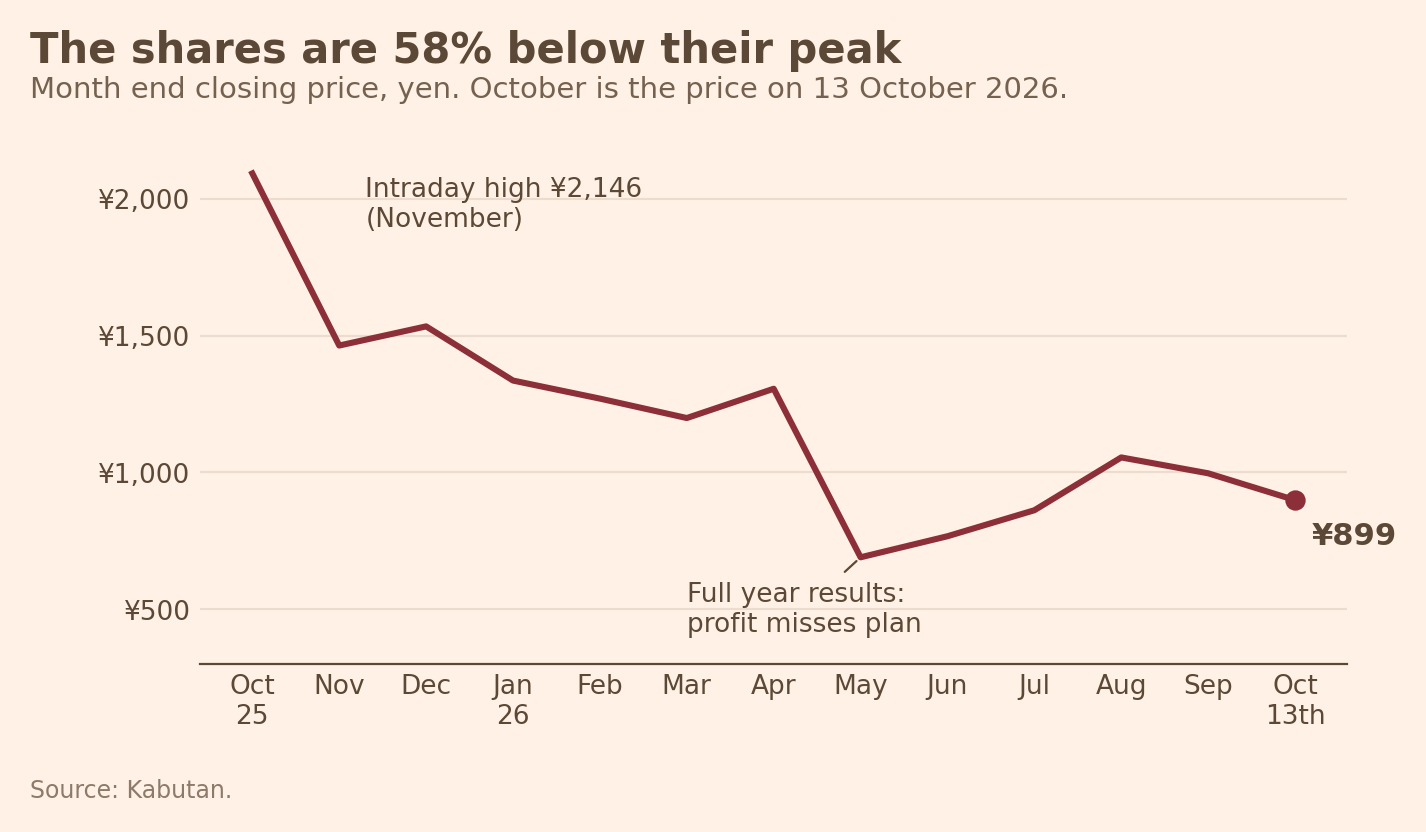
Until recently Ai Robotics sold mostly online, through its own website, Rakuten and Amazon. But about 90% of beauty products in Japan are bought in shops, so it now sells to drugstores too. Wholesale rose to 34% of sales last year, and the target is 70% to 80%. Shops pay about half the retail price, which is the main reason the gross margin fell from 78% to 63% in just over a year. Getting into the shops also cost about ¥1.8bn last year and left operating profit ¥1bn below plan. Management expects lower advertising costs to make up for the lower margin, but the June quarter still ended with a small operating loss.
The founder
Makoto Tatsukawa is 41 and on his second company. In 2015 he sold his first startup, a small media company, to the listed online marketplace Enigmo, and a year later he founded Ai Robotics. He owns about 18% of the shares. He likes to talk about humanoid robots, and once the company is worth ¥1 trillion, he wants to explore the Moon and Mars.
In 2025 he borrowed ¥700m ($4.4m) against his shares to buy more. When the share price halved in May, after the weak annual results, he got four margin calls. He has not said whether he sold to meet them, but he now owns roughly 400,000 fewer shares than in March, about 3% of his stake.
What worries me
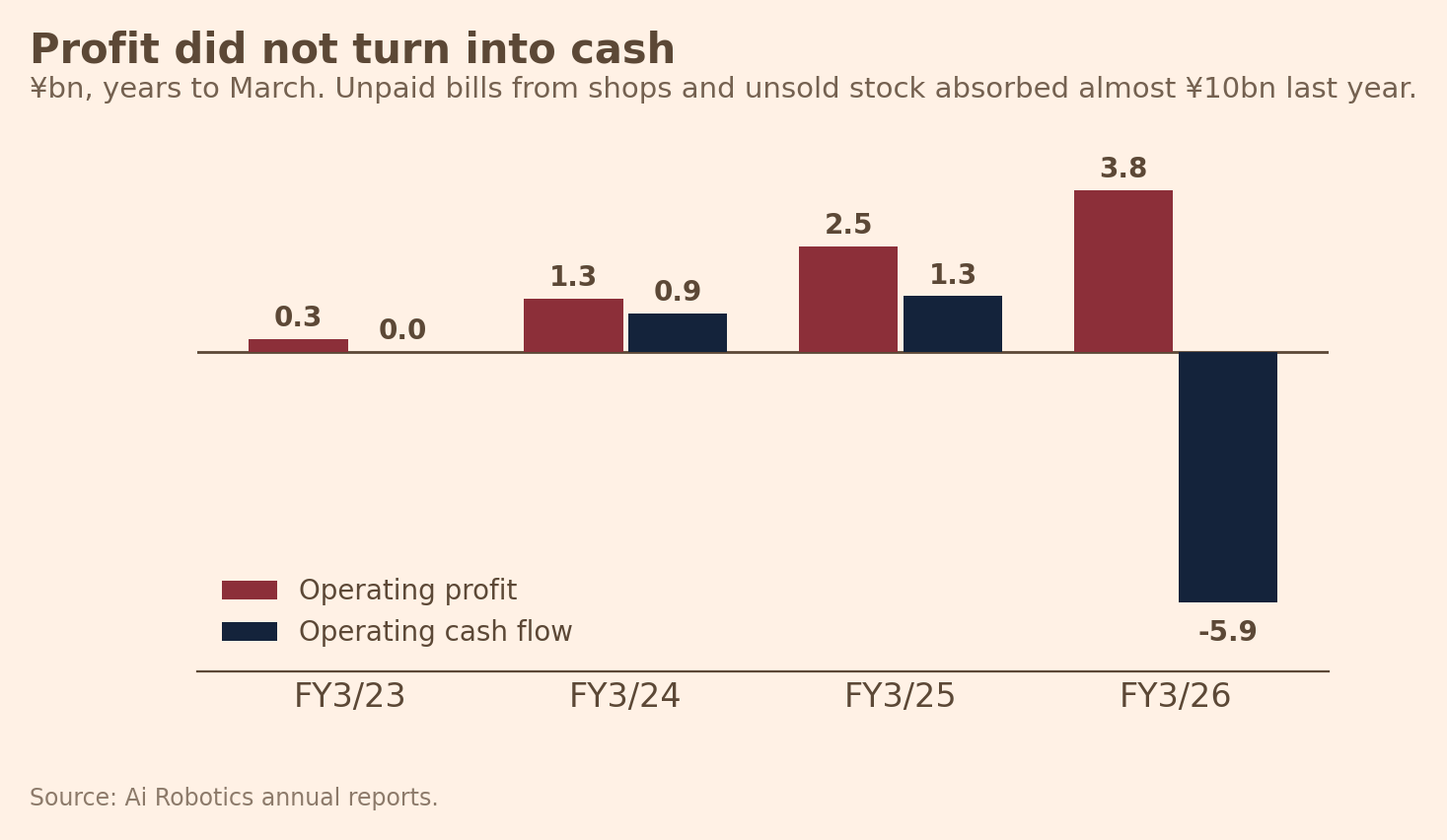
The first worry is cash. Last year the company made ¥3.8bn of operating profit, but operating cash flow was negative ¥5.9bn. Drugstores had not yet paid for many of their orders, and inventory kept building up. Much of that money has come in since, but inventory doubled to ¥9.7bn by June, partly because of BJC.
The second is that part of this year’s growth is bought. Without BJC, operating profit at the bottom of guidance would grow only 18%. Share options also added 11% to the share count last year.
The third is trust. Last December management admitted it sometimes delays sales to stay on plan, and then it missed its full-year profit target anyway.
The last is debt. BJC cost ¥25.55bn, and the company paid for all of it with borrowed money. Net debt is now ¥31.5bn against only ¥5.6bn of shareholders’ equity, and ¥10.55bn is a bridge loan due on 30 December. Management promises not to issue new shares, but I would not rule it out.
My valuation
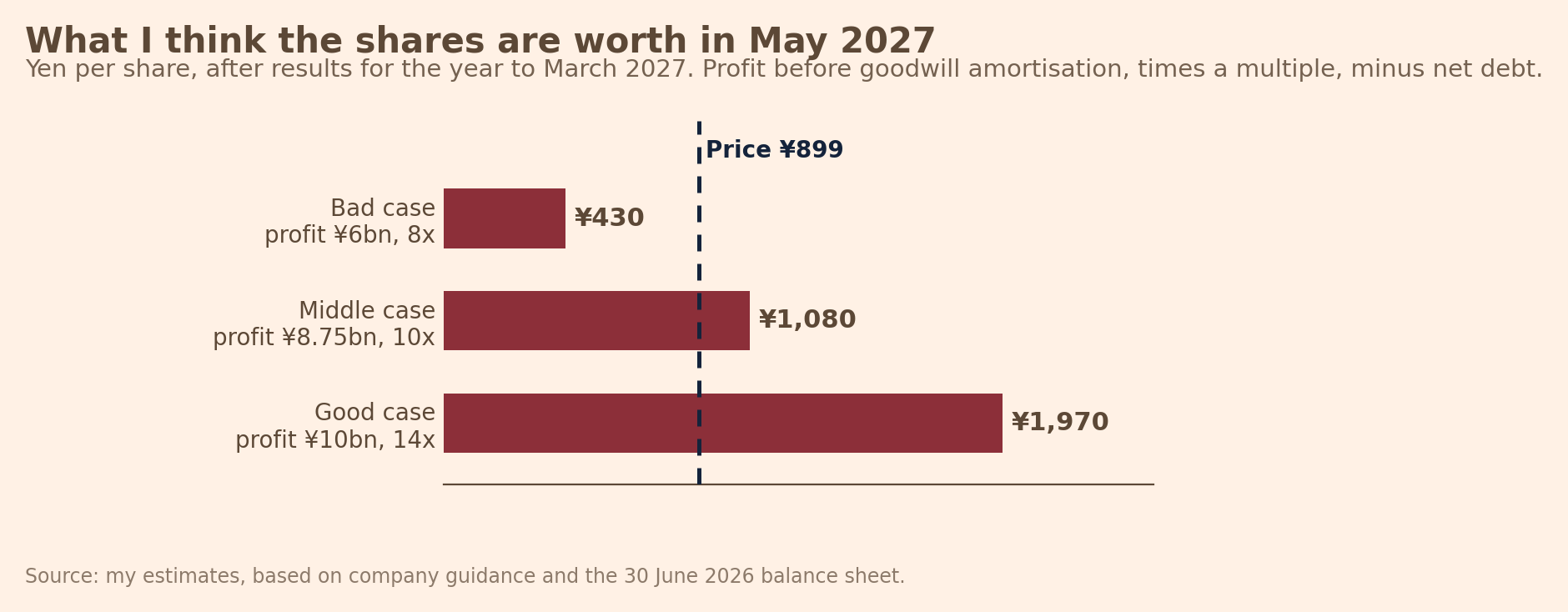
The company’s goal implies a share price 17 times higher by March 2029. That is hard to model, so here are three simple scenarios based on this year’s numbers. They all show what the shares could be worth in May 2027, after the results for the year to March 2027, using today’s net debt and share count. For each case I take reported operating profit and add back ¥1.4bn of yearly goodwill amortisation, which costs no cash. Then I apply a multiple and subtract net debt.
Bad case: operating profit of ¥6bn, 20% below the bottom of guidance, the same kind of miss as last year. At 8 times, about ¥430 a share, and less if new shares are issued.
Middle case: ¥8.75bn, the middle of guidance. At 10 times, about ¥1,080.
Good case: ¥10bn, the top of guidance, with next year’s plan still looking believable. At 14 times, about ¥1,970. That is still less than 10 times the operating profit the company plans for the year to March 2028.
What I will watch
Half-year results are due on 13 November. I will look at whether sales without BJC keep growing, whether profit recovers after the loss in the June quarter, whether inventory stops rising and whether operating cash flow turns positive. Then comes 30 December, when the bridge loan is due. The numbers do not have to be perfect. If the trend is right and the loan is refinanced without new shares, the middle case alone is about 20% above today’s price.
Conclusion
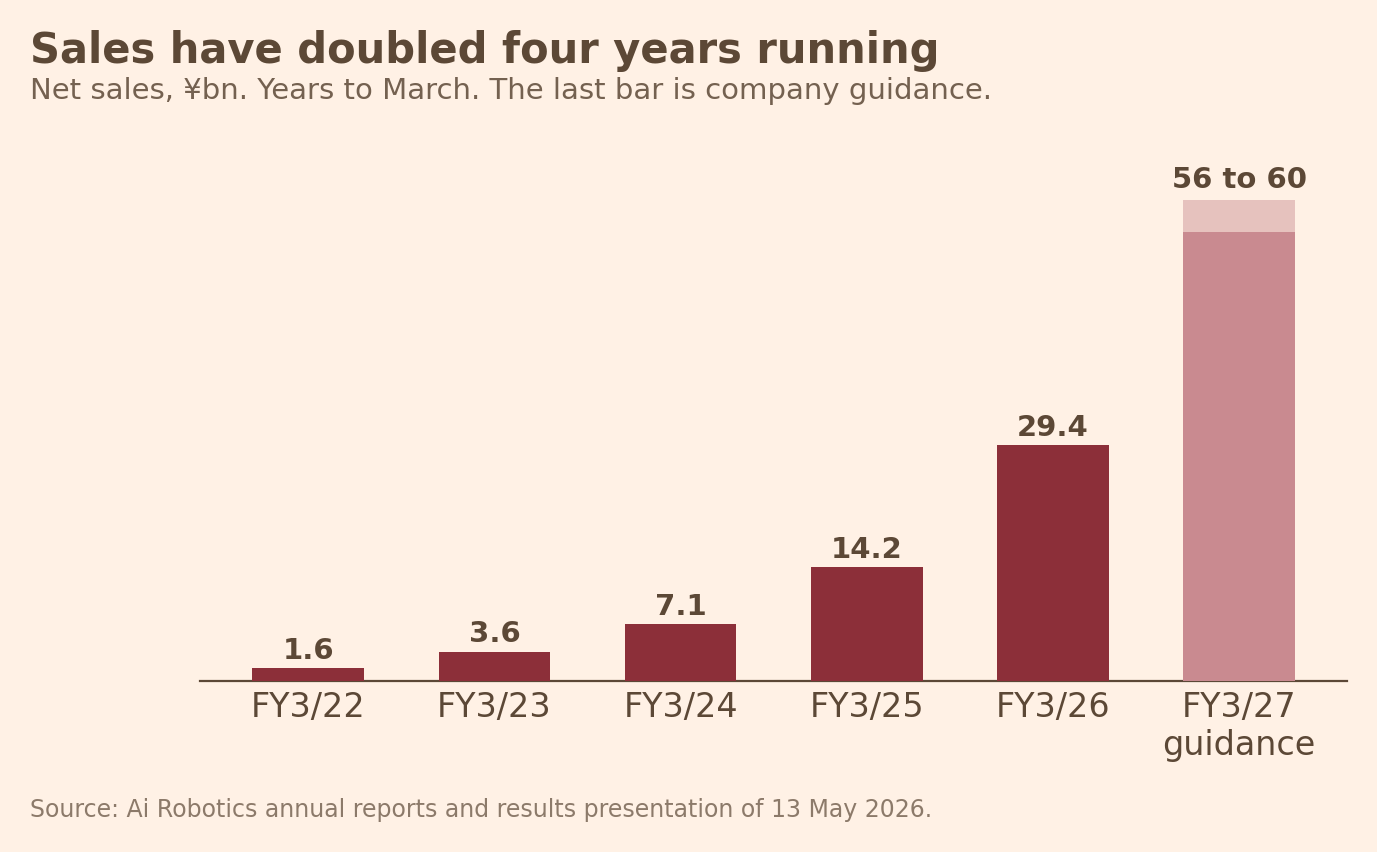
I do not know whether Makoto Tatsukawa is as brilliant as Elon Musk, whose style and dreams he seems to copy. But he has a very ambitious plan, he has built a marketing machine that works, and so far he has delivered. Sales have doubled every year for four years, from ¥1.6bn to ¥29.4bn, with only 36 permanent employees before the BJC deal. This is a bet on the jockey, more than on the horse.
You also do not overpay for that growth. On this year’s guidance the forward P/E is 10 to 14. I expect net profit to grow 60% to 120% this year, so the PEG (P/E divided by growth) is only about 0.1 to 0.2. Even without BJC, it stays below 1. The BJC deal was not expensive either, at about eight times BJC’s operating profit for its last full year. Return on capital was about 38% before tax last year. At the middle of guidance, and with goodwill included, it should still be around 24% after the deal.
Because of the debt, small changes in profit move the share price a lot. If the company misses again, I think the shares are worth around ¥430. If it reaches the top of guidance and next year’s plan still looks believable, they could be worth close to ¥2,000. The upside is more than twice the downside, so this may be a risk worth taking even with the heavy borrowing.
Most of my research covers Korean and Japanese small caps that almost nobody writes about in English. If this one was worth your time, you may also like my write-ups on PROTIA and KeePer Technical Laboratory.
Sources. Ai Robotics filings on EDINET and TDnet (annual reports for FY3/2025 and FY3/2026, the first quarter results, the BJC and loan notices, and the founder’s large shareholding reports), the company’s results presentations and question and answer summaries, Philipp Haas on Substack, and Kabutan for share prices. Valuation scenarios are my own. Market data as of 13 October 2026, share price ¥899, ¥158 to the dollar.
How I work. I read the Japanese filings myself. AI helps me with translation and with checking the arithmetic. Every judgement, model and conclusion here is mine.
Disclosure. Assume I own shares in every company I write about, and read accordingly. I don’t disclose individual positions or sizes.
Disclaimer. This is analysis for discussion, not investment advice, and not a recommendation to buy or sell anything. I’m not your adviser. The figures come from primary filings but I make mistakes, so check them yourself before you act. Micro caps carry real liquidity and volatility risk, and you can lose your money.