

A 150% Return on Capital, a 15% Yield, and a Catch: The Korean Microcap the Screeners Miss
A dominant little business, a mountain of idle cash, and a controlling parent. I read the filings so you can decide whether the discount is a trap or a gift.

Pull up IB Kimyoung (KOSDAQ: 339950) on any screener and you see a dull, cheap Korean education stock: a mid-single-digit multiple, a 1.5% yield, revenue creeping up. You move on.
You would be wrong to. That 1.5% is a year stale; the real dividend is worth over 15% at today’s ₩2,650. A third of the market value sits in cash. The core business earns more than 150% on the capital it uses. And still the stock is ignored, uncovered and cheap, because everyone who glances at it sees the same three things: a company controlled by its parent, a top line that looks like it is shrinking, and profits flattered by accounting. Trap, or gift? The answer is in the filings, so I read them.
The case against it
Start with the bear case, because it is real. Megastudy owns 55% and runs the board. Group operating profit has swung all over the place: a loss in 2020, a peak, a trough in 2022. A fifth of last year’s profit came from a single one-off. And the company sits on cash it will not return, choosing instead to buy an office building, park money in private funds, and pour capital into a subsidiary that loses money every year. On the surface this is a controlled, erratic, cash-trapping microcap. Now here is what the surface hides.
What you are buying
IB Kimyoung runs the cram schools that prepare students for Korea’s university-transfer exam. You spend two years at a lower-ranked school, sit a hard entrance exam, and move up into the third year of a better university: you do not lose the time, you trade up. Its brand has led that market since 1977 and coached roughly 189,000 students through it. It is dominant by a distance, with 21 academies where rivals run two or three, the most-used textbooks and the most exam-takers in the country, and a share last measured near 80%. It owns the whole chain, from its own research lab to its own bookstore.
The one thing to test is durability, and it cuts both ways. This is a one-shot business: a student passes, transfers, and never comes back, so the company refills its classrooms from scratch every year, and demand rides on an exam system the government can redraw. The moat is real. It is a moat around a gate someone else controls.
The core does the work
Now the numbers the screen buries. Split operating profit by segment and one part carries the company: the core earns about ₩20bn, the beauty arm ₩0.5bn, the IT arm loses ₩1.6bn.
It earns that on almost no capital. Students pay months before the first class, so the business runs on their money, not its own; that prepaid float reached ₩27bn by the first quarter. It leases its classrooms and owns little else. Gross margin has held above 70% for years, and cash beats profit: operating cash flow was ₩32.8bn last year against ₩20.1bn of net income, and free cash flow has averaged about 120% of earnings over three years.
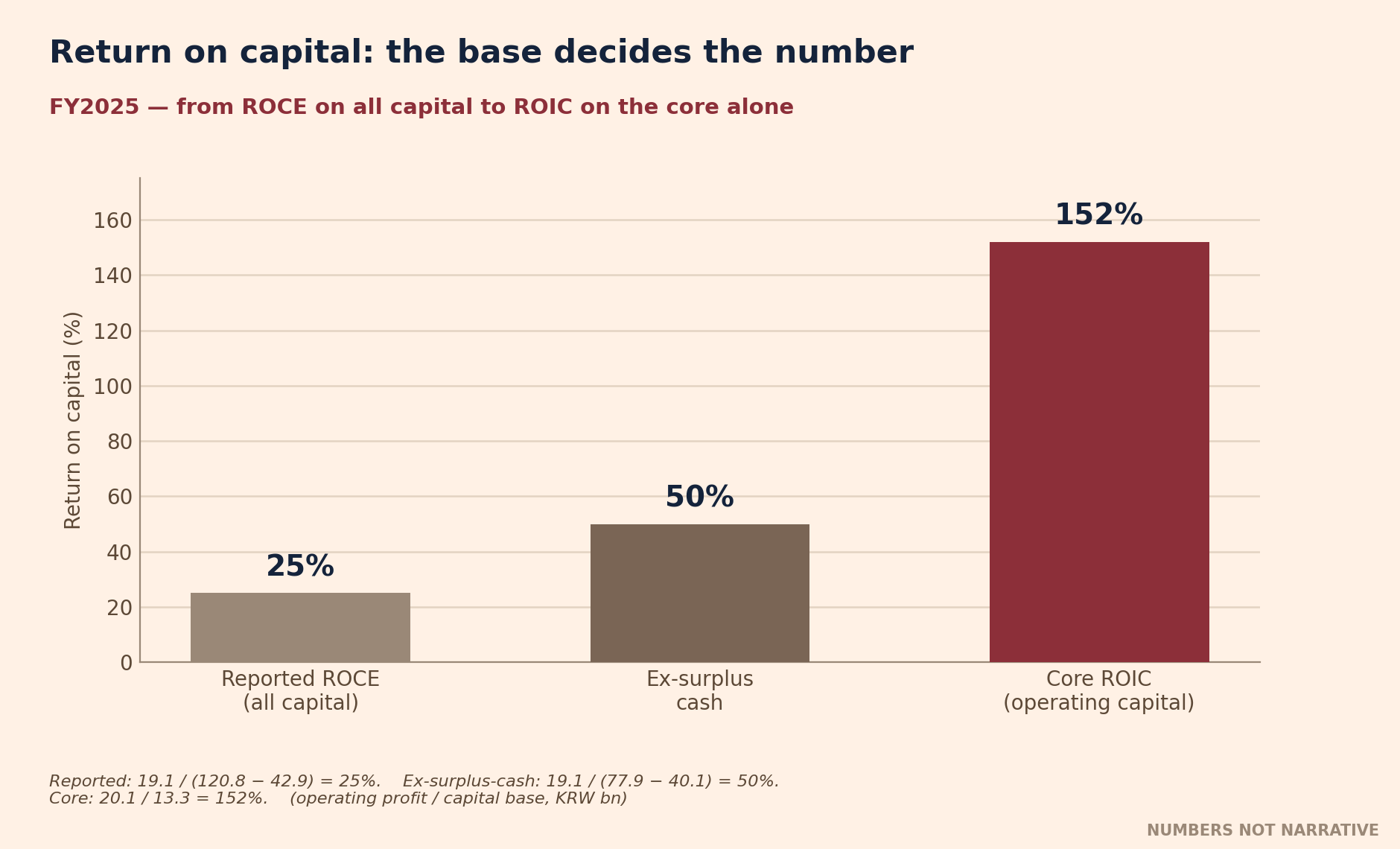
Measured against all its capital, return on capital is about 25%, because most of that capital is idle. Strip the surplus cash and it is 50%; count only the ₩16bn the core actually uses, and it is about 152%.
And there is the problem hidden inside the strength. A business this profitable and this light cannot spend its own cash. The core needs ₩16bn and throws off ₩20bn a year, so the surplus has nowhere to go inside the business, and that is precisely how it ends up in an office building and a stock portfolio. A 150% return you cannot reinvest is a cash machine, not a compounder, and that distinction decides how you value the whole thing.
The shrinking is mostly accounting
The shrinking is an illusion too. The core grew for years, revenue from ₩56bn in 2021 to ₩84bn in 2024, profit from ₩12.7bn to ₩20bn, before slipping 3% in 2025 on the sale of a small division to the parent.
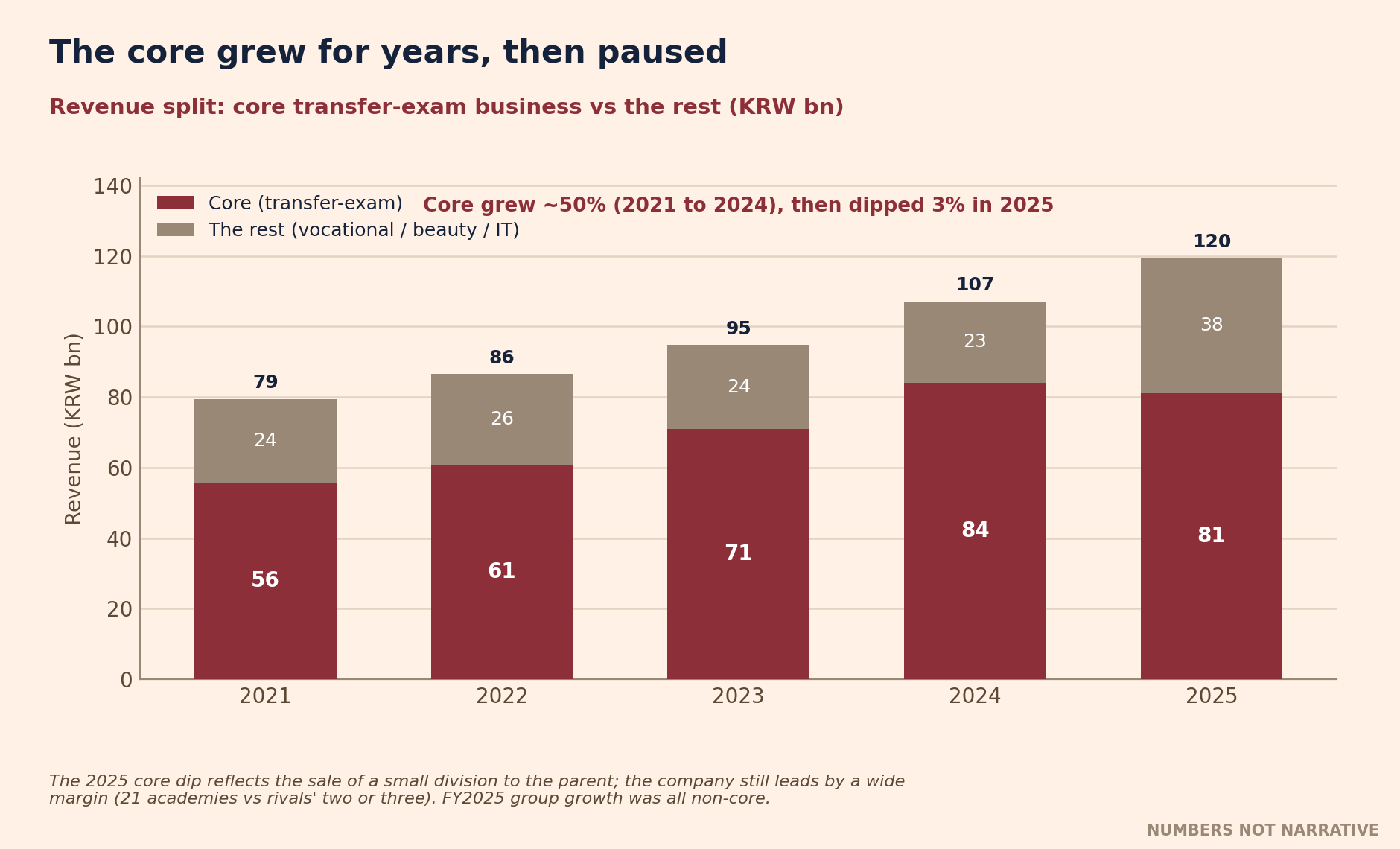
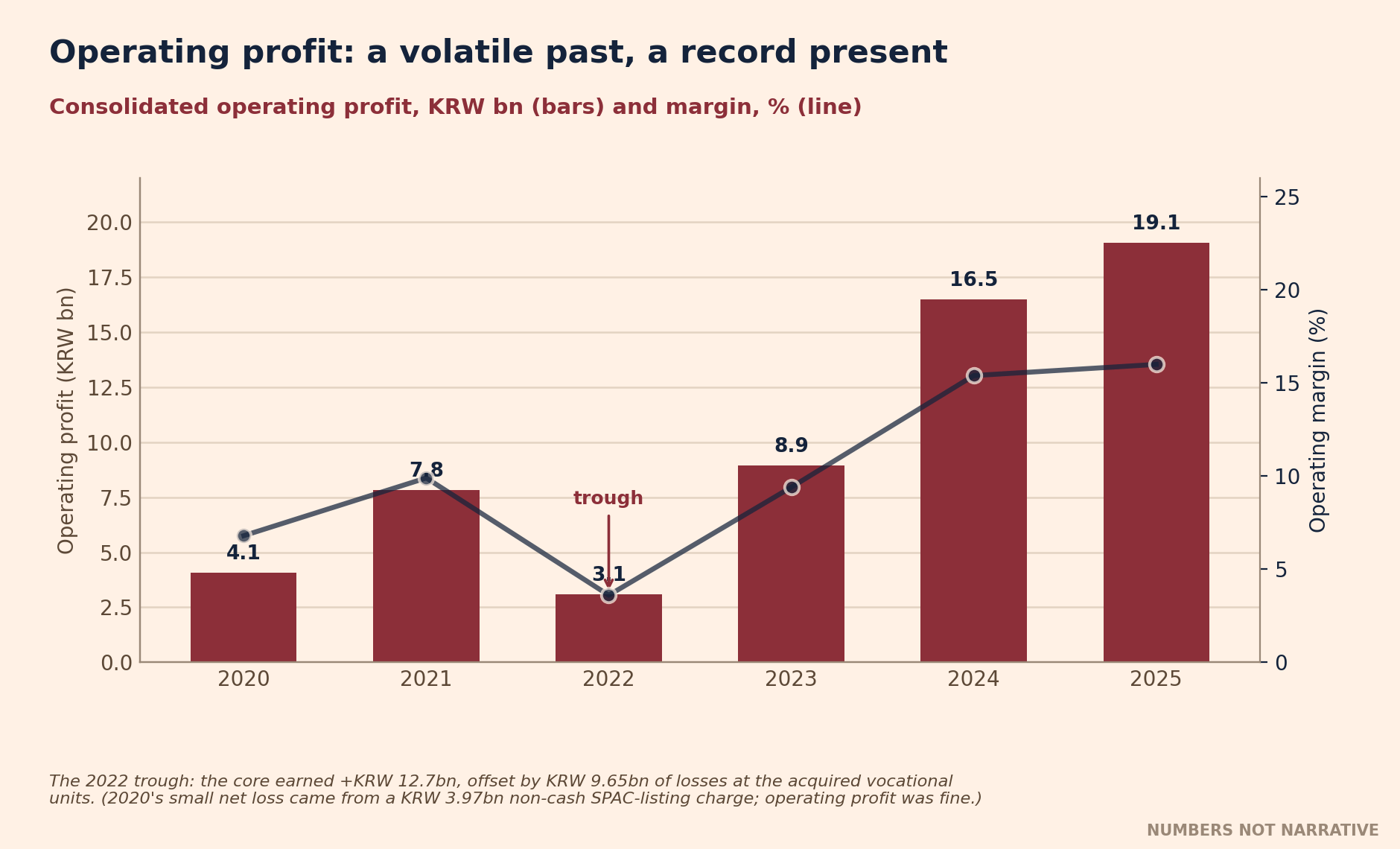
The lumpy history is the same story. The 2020 loss was a ₩3.97bn non-cash charge from listing through a shell, plus COVID; operating profit that year was fine. The 2022 trough was the loss-making academies the company had just bought, one taken over by converting unpaid debt into equity, dragging a ₩12.7bn core to ₩3.08bn at the group line. Consolidation hid the core; it was never the problem.
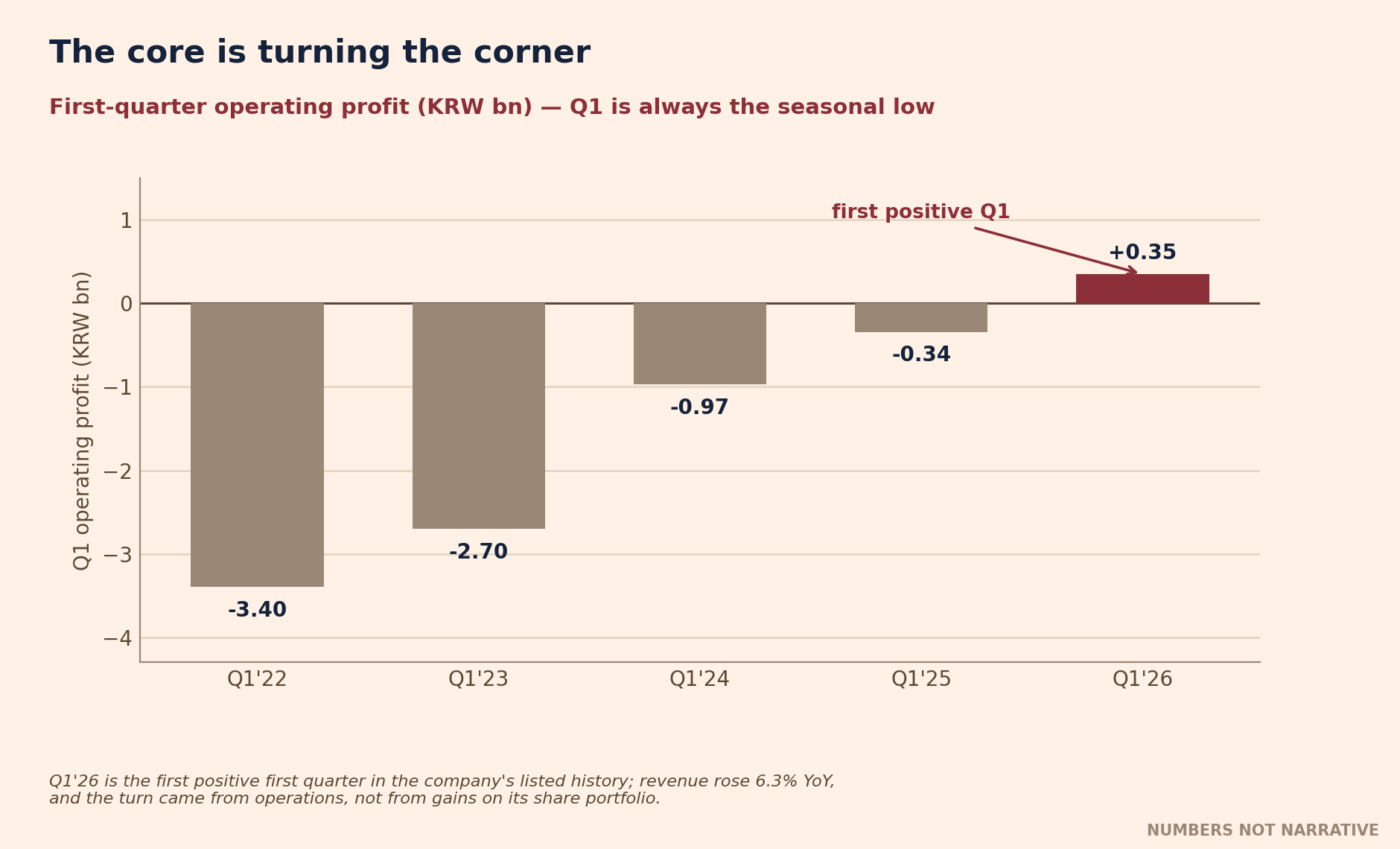
And it is turning up. The first quarter is always the seasonal loss, and that loss has narrowed every year to a first-ever profit in early 2026, on revenue up 6.3%.
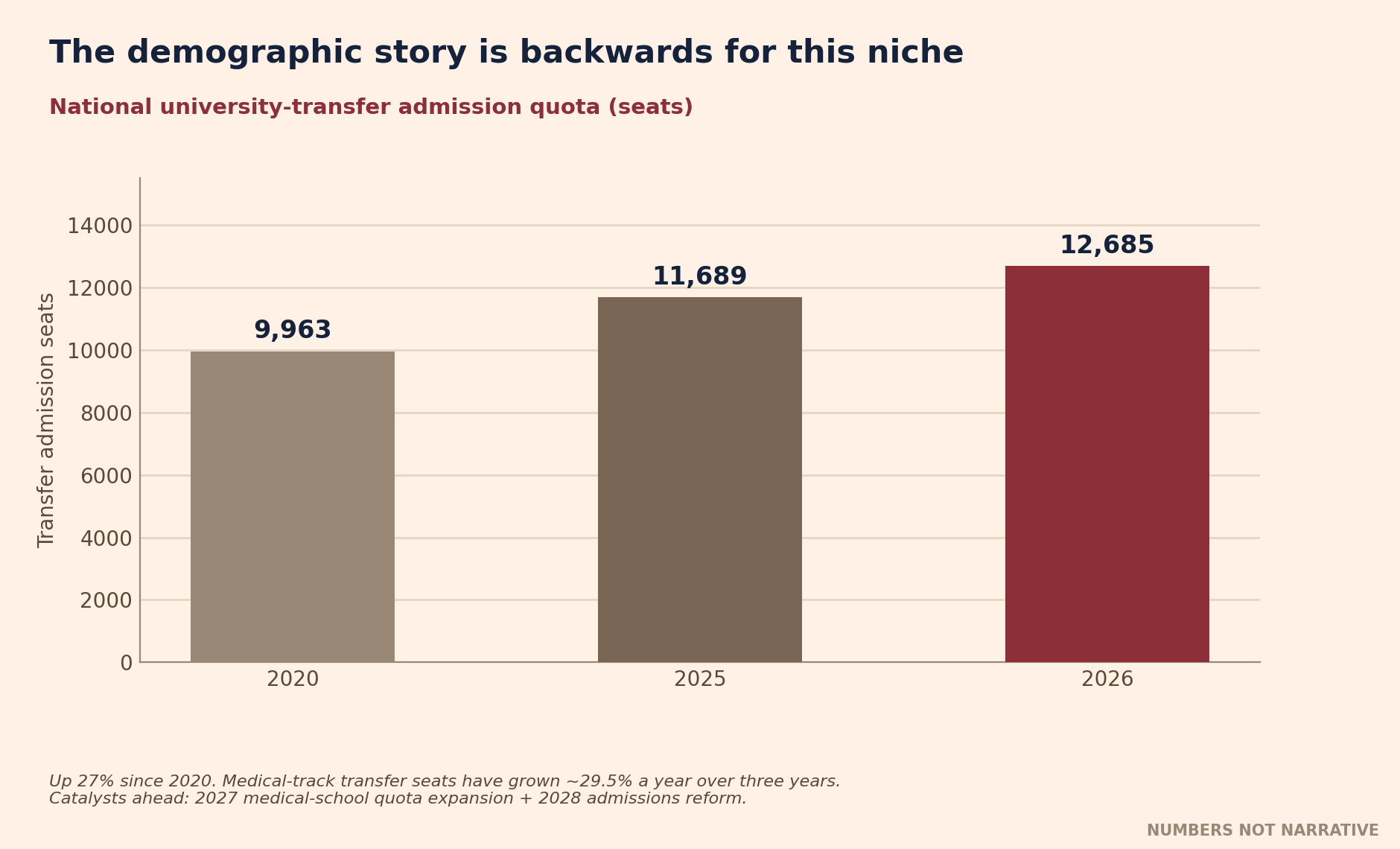
The market behind it grows, not shrinks: the transfer quota is up 27% since 2020, a hard-won medical-school expansion lands in 2027, and an admissions reform follows in 2028. More students drop out every year, and dropouts are what feed transfers.
Where the cash goes
So the bear case had one true point, the cash, and this is where it goes.
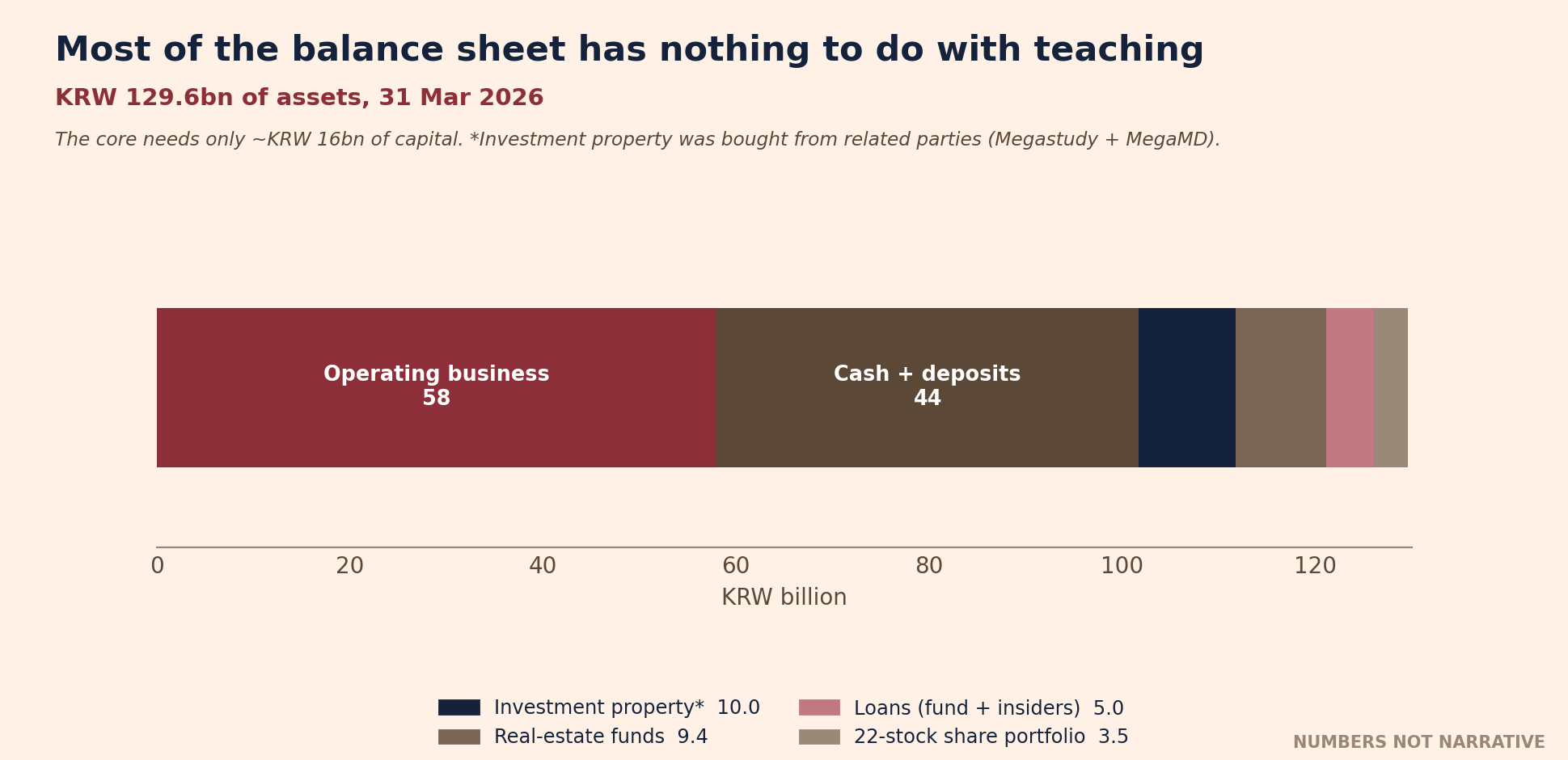
Of ₩130bn in assets, ₩44bn is cash and deposits, ₩10bn an office building, ₩9.4bn private real-estate funds, ₩5bn loans, and ₩3.5bn a portfolio of listed shares. The property came from the parent and another group company; ₩4bn of the loans went to a fund and ₩0.5bn to the company’s own managers. And the worst of it: the IT subsidiary had a ₩14bn hole in its equity, and in January the company put ₩14.5bn into it, the injection almost exactly the size of the hole. That is a rescue, not an investment. The same instinct shows in the share count, where 1.58 million treasury shares sit uncancelled since listing while 1.23 million new options were handed out below today’s price, diluting you for no reason the treasury could not have covered.
The dividend
Against all that, the payout has turned generous. Last year’s was ₩300, ten times the year before; from July the company pays ₩100 a quarter, which if held is ₩400 a year, near a 15% yield.
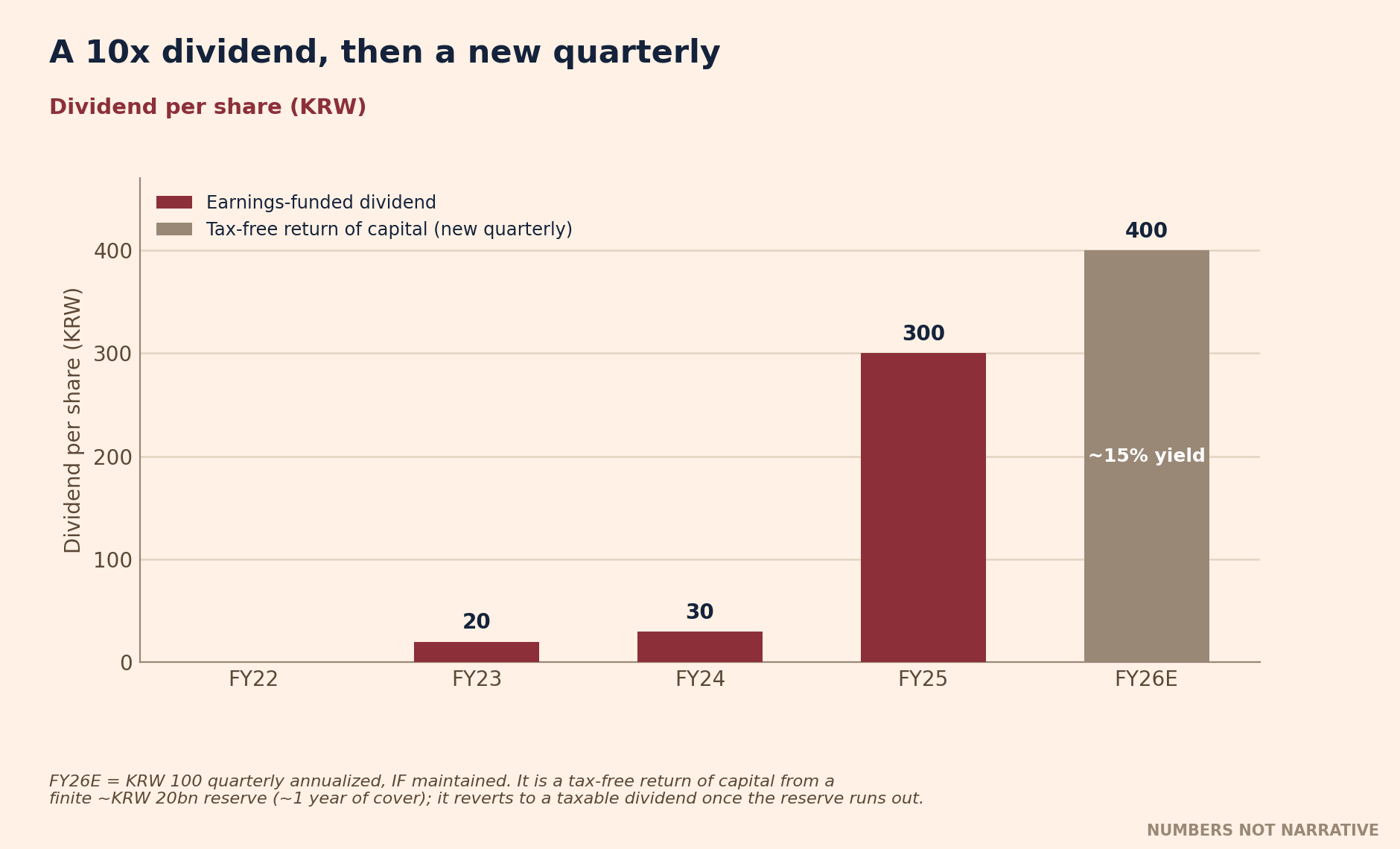
It is covered. ₩400 costs about ₩17bn against ₩20bn of free cash flow, so earnings pay for it and the ₩42bn cash pile stays put: the yield and the cushion are not the same money. For now the payout is dressed as a tax-free return of capital, which lasts about a year; after that the same dividend simply becomes taxable. And notice the aligned incentive: the parent wants cash, and the cleanest way it gets cash is by making this company pay it, which every minority holder collects at the same rate.
What it is worth
Value it in parts. The core earns ₩20bn of operating profit, ₩16bn after tax; at a conservative 8 to 10 times, that alone is ₩130bn to ₩160bn, above the entire ₩115bn market cap, and even at six times it roughly equals the whole company’s price. Add ₩42bn of net cash and, at a haircut, ₩25bn for the rest, and a sober sum runs past ₩200bn. Or more simply: strip out the cash and the non-core and you pay about ₩48bn for a business earning ₩20bn, under 2.5 times EV/EBIT.
The catch keeps it cheap. This is a controlled company, and the record, an office bought from the parent, cash poured into the losers, a one-off gain from selling a division to the parent at a price no outsider could test, says the controller allocates capital for itself, not for you. Good management allocates like an owner; this one allocates like a parent with other priorities.
But the case does not need the controller to reform, which is what most people miss. You are paid three ways, and only the last depends on him: the core alone, under 2.5 times EV/EBIT, a dominant franchise on a distressed multiple; a roughly 15% yield, paid from earnings, that pays you to wait; and, for free on top, ₩42bn of cash and non-core assets a buyback or a Value-Up push could one day surface. If the third never comes, the first two still stand.
So it is not a compounder and not a clean buy. It is a dominant little business, cheap, paying you well to wait, wrapped in a shell whose owner has not yet worked for you. Watch three things: whether the quarterly dividend holds, whether the non-core buying stops, and whether the treasury is ever cancelled. Any one would say the parent has begun to care about the price.
Until then, the numbers say a fine business is on sale, and the narrative, controlled, shrinking, propped up, is what keeps it cheap. Reading the filings is how you tell them apart.
Disclaimer: This article is for information and discussion only. It is not investment advice, a recommendation, or an offer or solicitation to buy or sell any security. It reflects my own analysis and may contain errors; figures are drawn from company filings and public sources and have not been independently verified. I may hold positions in the securities mentioned. All investment carries risk, including the loss of capital. Do your own research and consult a licensed adviser before making any decision.